Rachel Bosher was born in about 1721, the daughter of Charles Bosher, a Bristol merchant tailor, and his wife Rachel. On 4 February 1748 Rachel Bosher was married at St Mary’s church, Bathwick, to Robert Goadby (1720–1778), formerly a Bath bookseller who in 1744 became proprietor of the Western Flying Post, or Yeovil Mercury.
Robert and Rachel Goadby spent the first years of their married life in Yeovil, where Robert published the Western Flying Post from The Bow on the corner of Wine Street and High Street.
In January 1749, Robert Goadby merged the Western Flying Post with the Sherborne Mercury (est. 1737), which was then run by Hannah Bettinson the widow of the newspaper’s founder William Bettinson (d.1746). Robert and Hannah announced the merger of their newspapers in a joint statement in the Sherborne Mercury on 23 January 1749:
‘The proprietors of the Sherborne Mercury, or Weekly Advertiser, and the Western Flying Post, or Yeovil Mercury, beg leave to inform the Public that they have agreed to unite the said Papers, to begin the Sixth of February, and to Print and Publish them at SHERBORNE under the title of the Sherborne and Yeovil Mercury, which by means of this Union, will be rendered the most numerous and extensive paper in Great Britain. All persons therefore who may have occasion to advertise in the said Sherborne and Yeovil Mercury are desired to send their Advertisements to R. GOADBY and Company, at the Printing Office in Sherborne aforesaid, where Printing business of every sort is performed in the neatest manner, and on the most Reasonable terms.’
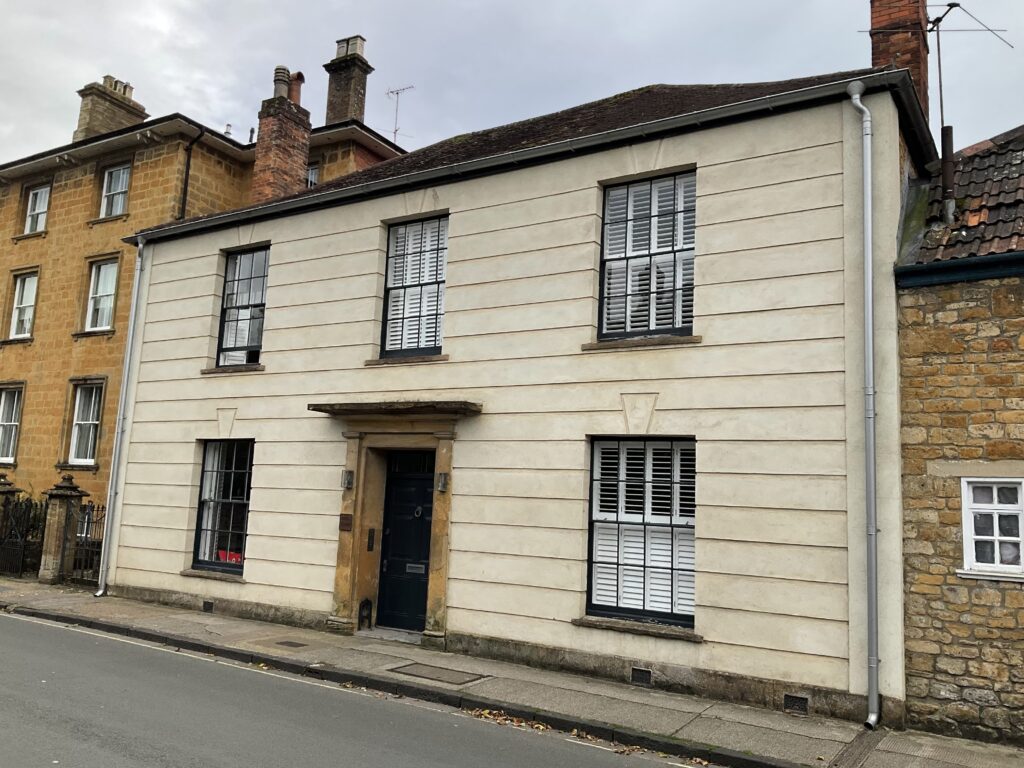
Robert and Rachel Goadby moved to Sherborne, taking over the Bettinson’s printing office (now Bute House) in Long Street. Above the entrance to the printing office an inscription proclaimed Robert Goadby’s belief in the freedom of the press:
‘THE SHERBORNE PRINTING HOUSE.
THE LIBERTY OF THE PRESS AND THE LIBERTY OF THE PEOPLE FALL TOGETHER.
MAY HEAVEN LONG AVERT IT.’
On 22 February 1749, Robert and Rachel’s only child Robert was baptised in Sherborne Abbey. Sadly, he died seven years later and was buried in Sherborne Abbey on 2 February 1756.
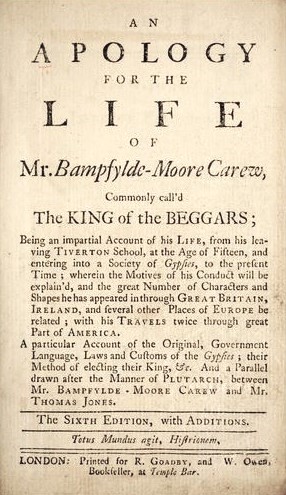
In 1749 Robert Goadby published An Apology for the Life of Mr Bampfylde Moore Carew, commonly called The King of the Beggars. Rachel Goadby is credited with having taken down the account which Bampfylde Moore Carew (1690-1758) dictated to her.
Robert Goadby was involved in the civic and cultural life of Sherborne, becoming a governor and warden of the King’s School (now Sherborne School), serving as surveyor of the highways, and in 1765 he opened a subscription library in Cheap Street. He is said to have walked daily to St Cuthbert’s Church (now the Old Chancel) at Oborne, and it was his wish that he should be buried there ‘not in consecrated ground.’ His lifelong interest in the welfare of the poor and a love of nature were reflected by his will in which he left £200 to provide an annual sermon to be preached in Sherborne Abbey on ‘the Works of Creation’ and for alms to be distributed to the poor of the town.
Following Robert’s death in August 1778, Rachel took over as proprietor of the Sherborne Mercury, which by 1788 was handled by an agency network consisting of 37 agents based in 28 towns, including Bristol and London.

Rachel was obviously an astute business woman with an eye for an opportunity and, alongside the Sherborne Mercury, she published a periodical – The Weekly Miscellany; or Agreeable and Instructive Entertainer… A Work formed for the entertainment of the purchasers of the Sherborne Mercury. A surviving copy of The Weekly Miscellany, dated 23 December 1782, priced at one penny ‘though as much in Quality as is sold in London at Three-pence’, contains ‘twenty-four pages of letter press, on a good paper and letter, including a variety of select pieces both in prose and verse. Curious anecdotes, instructive talks, the best political pieces of the times, and ingenious essays on different subjects.’ This issue was printed with the Christmas market in mind, as the notice to ‘To the Public’ on the back cover makes clear:
‘As every one devotes some part of his time to relaxation, it is of importance to society, that mankind should be furnished with proper amusements, in which to employ their vacant hours. Upon this plan was this work founded. A work, in which readers of the most different tastes may find entertainment. Here the lover of amusing narratives and the admirers of history and travels will find something suited to their respective tastes. Here the votaries of the muses may find some pieces which will merit their applause. Here the lover of wit and humour may be furnished with laughable stories and humourous anecdotes. Here the politician will find the most important state papers of the times. And here the ingenious arithmetician, the curious querist, and the puzzling enigmatist may amuse themselves in the respective ways to which their inclinations particularly lead them. We shall only add, that is shall be our constant endeavour to merit approbation, by a careful selection of the most useful and entertaining pieces.’
This volume of The Weekly Miscellany contains the following articles and poems:
Account of the Hewling family and their links with Oliver Cromwell, by Agathos Pais, Taunton, 4 November 1782. Includes reference to William Hewling, Lieutenant of foot, who was executed at Lyme on 12 September 1685, his brother Benjamin Hewling, Captain of a troop of horse, and their sister Miss Hannah Hewling who married Major Richard Cromwell, grandson of Protector Oliver Cromwell.
The History of John of Calais.
Some account of the Parish of Brean, in Somersetshire, by Agathos Pais.
Anecdotes of Dr Lockyer and Dr Thomas, Bishop of Salisbury (from the memoirs of the late Bishop Newton, written by himself).
Anecdote of the Pretender, after his return from Scotland to Paris.
An anecdote of an incident in a village of the mountains of Avosta, in Piedmont.
A reflection.
On goodness of heart
An Ecclesiastical anecdote.
Inscription on a monument in memory of William Dalrymple, midshipman, eldest son of Sir John and Lady Dalrymple, to be erected in Westminster Abbey who was killed on board the Santa Margarita in an engagement with the Amazon French Frigate on 29 July 1782.
Answer by James Adams of East Stonehouse to T. Lyddon’s question, inserted 24 December 1781.
Answer by T. Penny of St Budeax to W. Kite’s question inserted 27 May 1782.
Answer by J. Whitcombe of Plymouth to J. Adams’s question inserted 8 October 1781.
Poem: Picture of a Good Wife.
Poem: No Real Pleasure or Felicity in this Life without the Hopes and Prospect of Immortality.
Poem: On a Lady who died in Child-Bed.

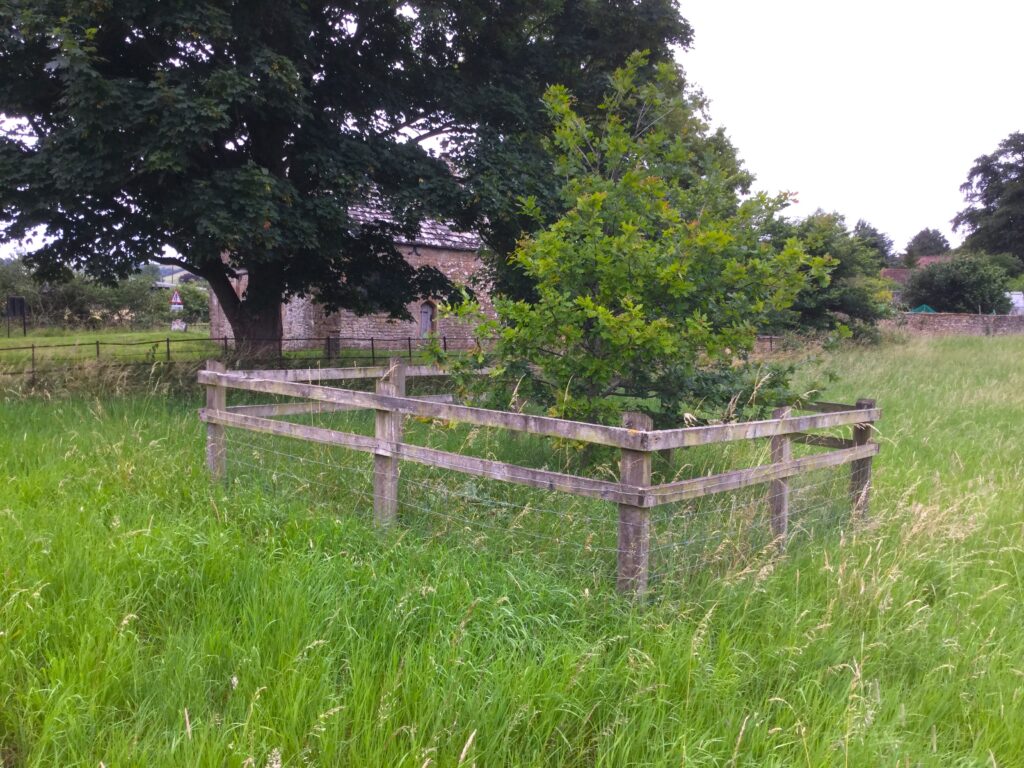
Rachel Goadby died on 30 March 1790 and was buried on 2 April 1790 beside her husband in the glebe land at St Cuthbert’s Church (now the Old Chancel) at Oborne, Dorset.
By her will, made on 3 June 1785, Rachel appointed her niece Sarah Jane Douglas as her sole executrix and left bequests from her personal estate to her nieces Hannah Wilson, Sarah Jane Douglas, and Katherine Douglas, to her husband’s niece Margaret Klotz, and to the daughter of his niece Hannah Gardner/Gardiner. She also left bequests to her husband’s brother Samuel Goadby and to her husband’s nephew Samuel Lerpiniere.
Rachel Hassall
See also:
- Barry & G. Tatham, ‘Robert Goadby, The Sherborne Mercury and the Urban Renaissance in South-West England’(2018)
- Hannah Bettinson (née Baugh): Proprietor of the Sherborne Mercury newspaper 1746-1749.
- St Cuthbert Old Chancel, Oborne, Dorset, Churches Conservation Trust
- The Western Flying Post, Yeovil’s Virtual Museum
- Digital copies of The Weekly Entertainer, or West of England Miscellany, 1783-1824(Internet Archive)