Dame Margaret Gough, also spelt Gogh and Goffe, was the daughter of Sir Stephen Derby and his wife Avice Gulden (c.1348-1420). Sir Stephen was member of Parliament for Dorset 1379-1386, and also served as Receiver of the Clare estates in Wales and the marches 1360-c.1368, Steward of the estates of Lionel, duke of Clarence, 1365-1368, and JP for Dorset 1376-1389. In c.1361 Stephen married Avice Gulden, daughter and heir of Sir Alan Gulden of Langton Long Blandford. Sir Stephen and Avice obtained a royal licence in 1391 to support a chantry in the parish church of Long Blandford where masses were to be said for their souls and those of Avice’s relations. After Avice’s death on 18 April 1420, her estates passed to her eldest son Robert Derby.
Margaret married Morgan Gough, but the marriage was childless. Morgan Gough died on 7 March 1425 and Margaret died on 19 August 1441.
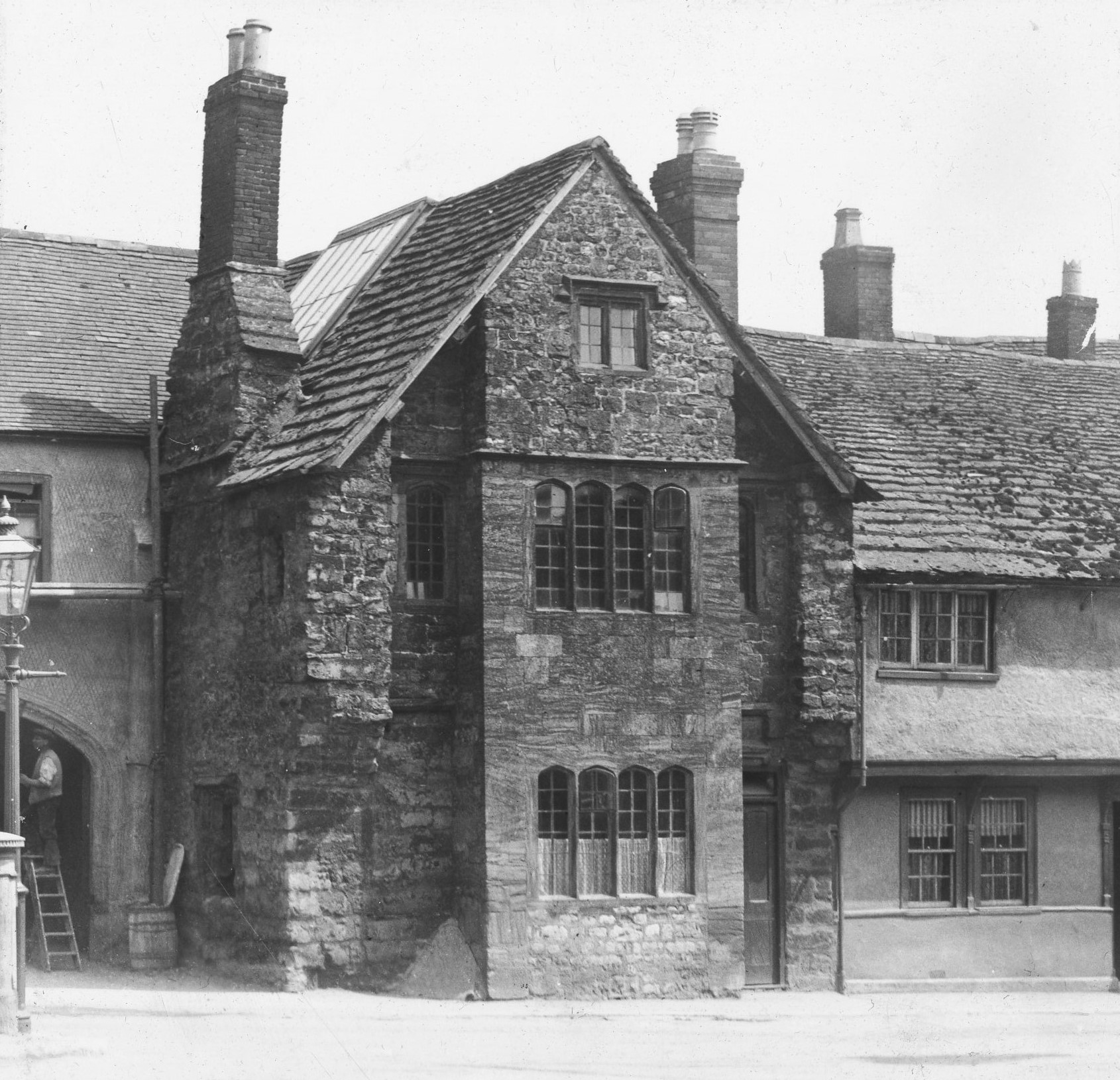
On 11 July 1437, a royal licence was granted by King Henry VI to found at Sherborne the Almshouse of St John the Baptist and St John the Evangelist to provide for twelve poor weak and impotent men and four poor weak and impotent women of Sherborne. The licence also appointed twenty brethren, a perpetual chaplain, and a master. This was in fact a re-foundation of an earlier almshouse known as Dodill’s Almshouse. J.H.P. Gibb suggests in The Book of Sherborne (1981) that the Almshouse of St John the Baptist and St John the Evangelist was probably built on the site of Dodill’s Almshouse.
The following twelve men and four women were transferred in 1437 from Dodill’s Almshouse to the new Almshouse:
Men: William Gore, John Salter the elder, William Floure, John Dale, Henry Baret, Robert Coscombe, John Garland, John Whynne, John Whyppe, Richard Welbys, Thomas Unwyn, John Whytlegh.
Women: Agnes Knyghttesse, Edith Merston, Julian Symmes, Alice Prior.
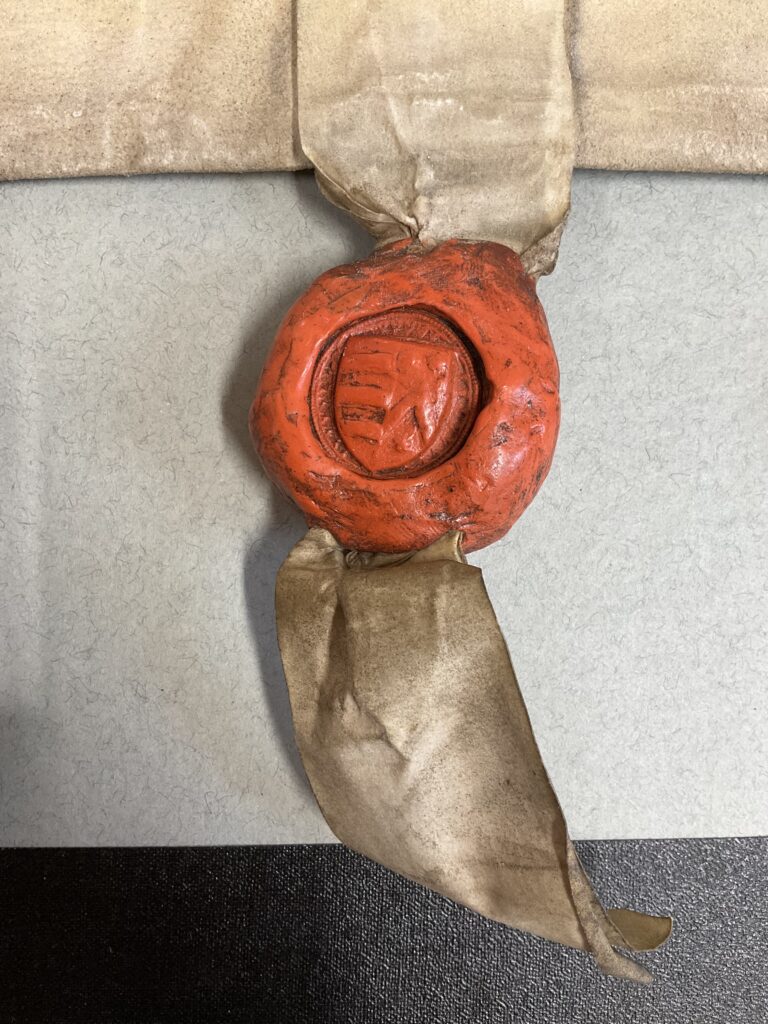
The Foundation Deed for the Almshouse is dated 10 January 1437/8 and bears the seals of five of the co-founders: Bishop Robert Neville, Sir Humphrey Stafford of Hooke, Sir John Fauntleroy of Caundle Marsh, John Baret/Barrett of Sherborne, and Dame Margaret Gough of Berwick [probably in the parish of Swyre, Dorset]. Margaret endowed the Almshouse with ‘a messuage called the Julyan on the green in Sherborne’. This was the Julian hospice at the top of Cheap Street in Sherborne, which Margaret had inherited from her parents. In Mediaeval Sherborne (1951) Joseph Fowler suggests that The Julian may have been named after the anchoress Julian of Norwich who wrote the first work in the English language which we can be sure was authored by a woman.
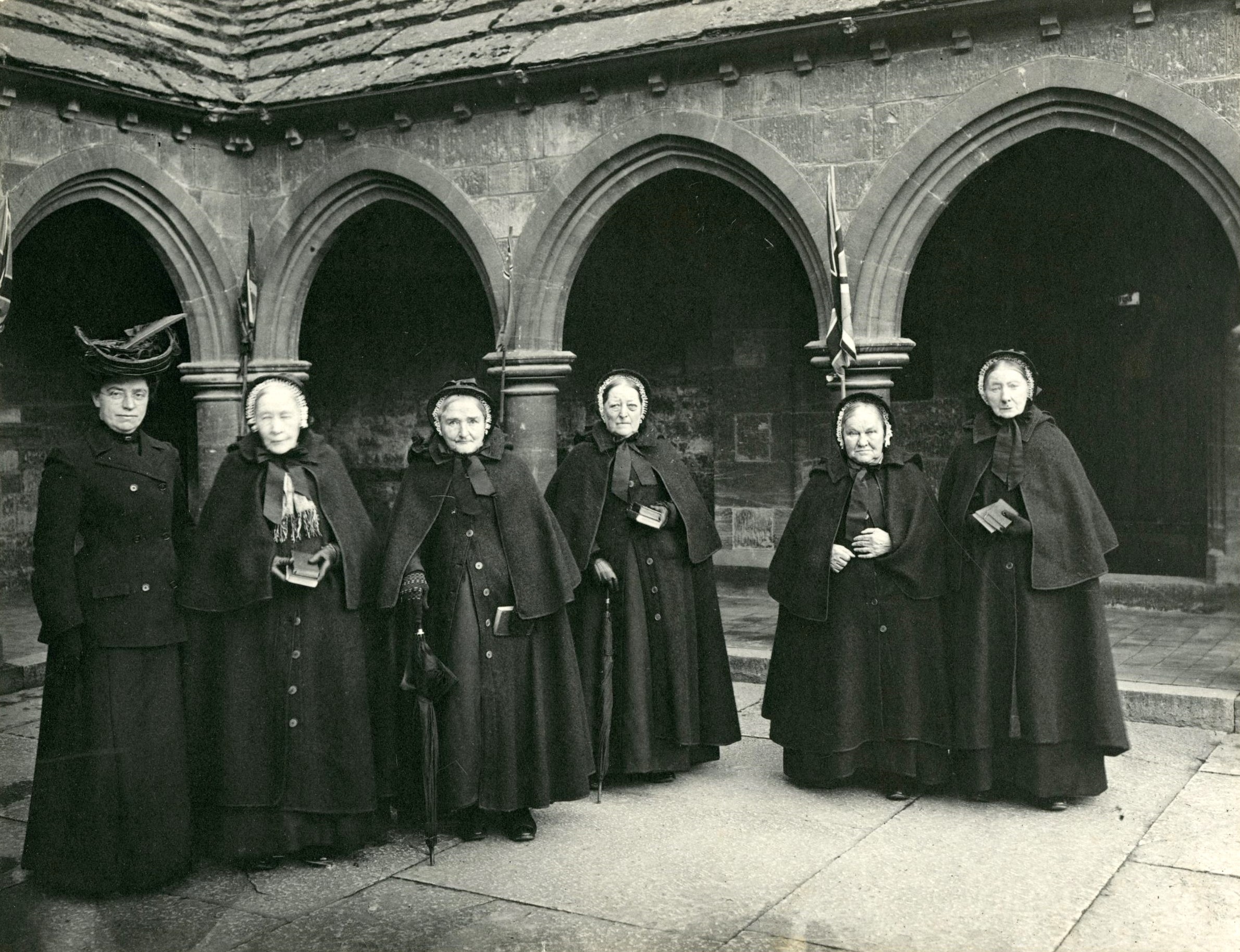
The Founders’ Statutes set out ‘that there shall be a woman in the said house who for the time being shall buy, order, make, fetch in and dress the victuals of the said sixteen poor men and women and serve them according to the order of the master of the said house for the time being and that she shall be called the housewife of St John’s House and that she shall wash the said poor men and women and make their bed etc. as the master shall direct and that she shall be satisfied for the same by the master of the said house.’ The sixteen poor men and women were also to be provided with cloaks, linen and woollen hose, and shoes, and at Christmas they were each to be given a new gown (with the bishop’s mitre embroidered on the right breast and the cross of St George on the left breast) and a new white woollen cloth hood.
The Founders’ Statutes also included an oath for the poor men and women and the housewife:
‘You shall swear that during the time that you shall be and continue one of the house to live by the alms thereof. You shall dutifully demean yourself to the master and brethren of this house. You shall be ordered, ruled and governed by the ordinances and rules of the same house. You shall not practice and commit nor consent to be committed any wrong, waste or disprofit to this house, nor in the goods or provision thereof, but knowing any to be committed or pretended you shall, without delay or concealment, reveal and make the same known unto the said master and brethren or some of them. And in all things so behave your self as one worthy the continuance of the company unto which you are now chosen upon your own instance and entreaty. So help you God.’
Further reading:
- Ann Clark (ed.), Sherborne Almshouse Register (Dorset Record Society, vol.17, 2013)
- Joseph Fowler, Mediaeval Sherborne (Dorchester: Longmans Ltd. 1951)
- J.H.P. Gibb, The Book of Sherborne (Buckingham: Barracuda Books Ltd., 1981)
- C.H. Mayo, A Historic Guide to the Almshouse of St John Baptist and St John the Evangelist Sherborne (Oxford University Press, 1933)
- St Johns’ House website
- Sherborne Almshouse archives (D-SHA), Dorset History Centre