On 14 October 1895, the annual Pack Monday Fair was held in Sherborne, Dorset, and the Rowland family were in town with their travelling show which they pitched in the Fair Field in Digby Road (now the Pageant Gardens).
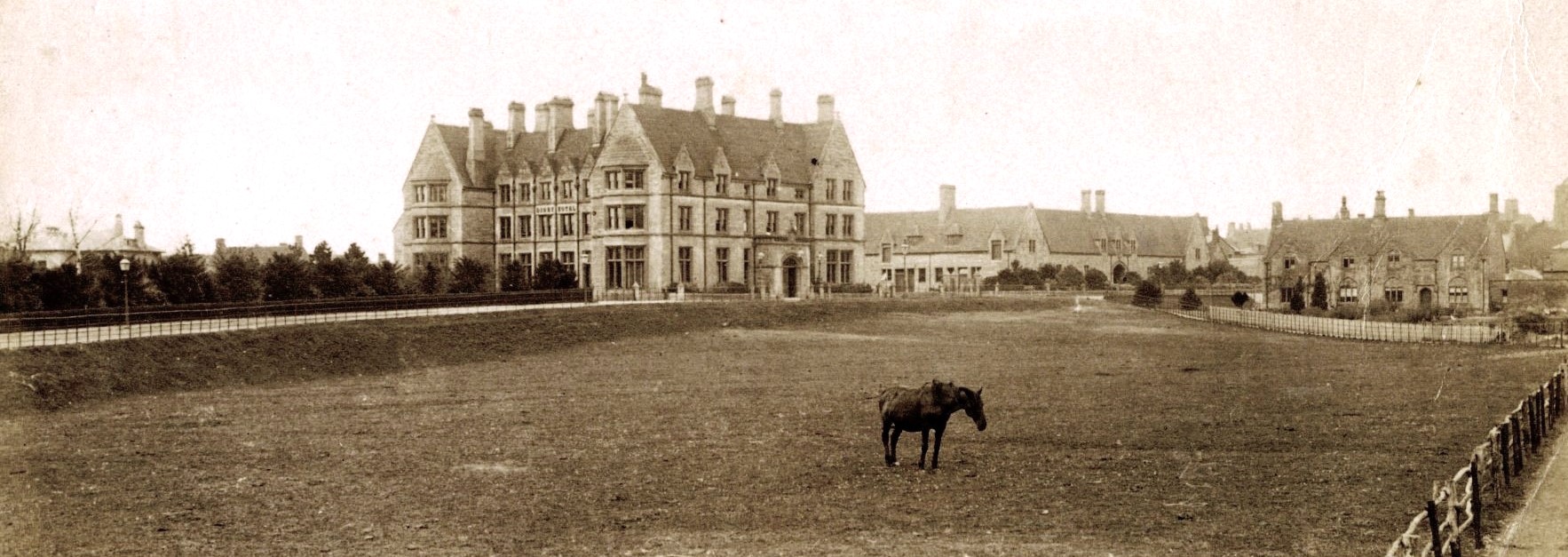
Thomas Rowland (1856-1926), a travelling showman, and his wife Betsy (née Smith) (1854-1923) had nine children, the birthplaces of which reveal some of the places the family visited with their travelling show:
- Amy Rowland (1874-1949) was born in Guildford, Surrey.
- Thomas Rowland (b.1879) was born in Woking, Surrey.
- William (Billy) Rowland (1881-1946) was born in Guildford, Surrey.
- Priscella Rowland (1884-1895) was born on 11 December 1884 at Meadrow, Godalming, Surrey, and baptised at St Mary’s church, Wilton, Wiltshire on 12 September 1885.
- John (Jack) Rowland (b.1884) was born in Crawley, Surrey.
- Joseph Rowland (b.1888) was born in Headley, Surrey.
- Lavinia Rowland (1890-1947) was born in Aldershot, Surrey.
- Albert Rowland (1894-1968) was born on 13 September 1894 in Glastonbury, Somerset, and baptised in Sherborne on 16 October 1894 [Pack Monday Fair was held in Sherborne on 15 October 1894]
- Jane/Janey/Jenny Rowland (b.1896) was born on 6 October 1896 in Abbas and Templecombe, Somerset. That year the Pack Monday Fair was held in Sherborne on 12 October 1896.
A newspaper report published in the Hampshire and Berkshire Gazette on 25 March 1893 provides an insight into what life was like on the road for the family:
‘On the afternoon of Wednesday 8 March 1893 Thomas Rowland arrived by train at Oakley, a village to the west of Basingstoke in Hampshire, and made for the Red Lion at Clerken Green where he asked for permission to put up his vans there the following night. Although the landlord refused Thomas’ request, the following evening he pulled up his vans in front of the pub and asked if he could put them in one of the landlord’s meadows, but on again being refused unharnessed his horses in front of the pub and defied anyone to move him! The landlord told Thomas he could rest his horses there for an hour, but when after an hour he didn’t remove them the landlord sent for P.C. Cooper. Thomas still refused to budge and told P.C. Cooper he would stay there the night if it cost him £30. At about midnight Police-Sergeant Wakeford arrived from Basingstoke and attempted to take the name from one of the vans, at which point Thomas ‘put himself in a fighting attitude’, but was apparently by then the worse for drink and fell over when the sergeant pushed him. In desperation, the landlord used one of his own horses to move the vans onto the road between the pub and the railway bridge, at which point Tom began shouting “murder” and called his wife Betsy and the children to do the same, which they did at the top of their voices! On being summoned to appear before the magistrate Thomas explained that on the night in question he was making his way from Andover to Aldershot but his horses, which were not in good condition, were exhausted by the time they got to Clerken Green and needed a rest, adding that if he had continued on to Basingstoke he would have been summoned for cruelty to animals. Thomas denied the charges of drunkenness and of encamping on the public highway but was convicted of both offences and ordered to pay fines and costs amounting to 25 shillings.’[1]
On 14 October 1895 the family arrived in Sherborne for the annual Pack Monday Fair, pitching their vans in Digby Road, and it was here that their 11-year-old daughter Priscella died on 18 October 1895. Her cause of death was given as measles and broncho-pneumonia.

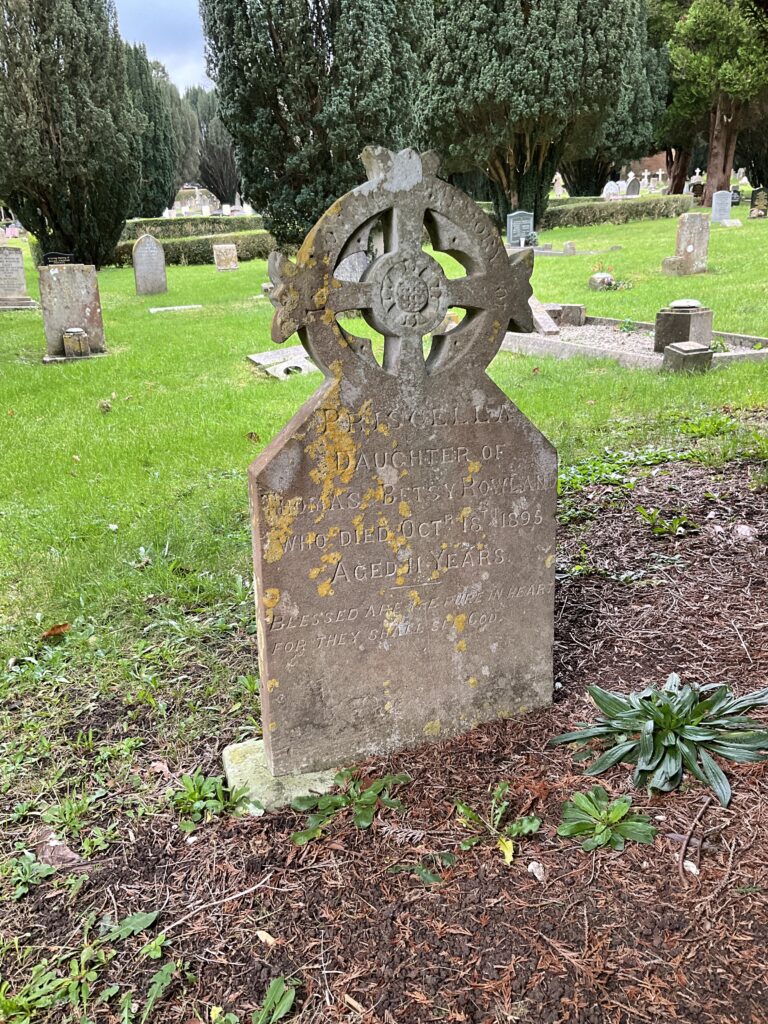
Priscella was buried in Sherborne Cemetery on 21 October 1895, where her headstone reads:
‘PRISCELLA DAUGHTER OF THOMAS & BETSY ROWLAND WHO DIED OCTR. 18TH 1895 AGED 11 YEARS. BLESSED ARE THE PURE IN HEART FOR THEY SHALL SEE GOD.’
In A Parish on Wheels, the Rev. John Howard Swinstead (1864-1924) who ran a Church Mission and School for Travellers in the Salisbury Diocese, includes the following account of what is evidently Priscella’s illness and sad demise:
‘But who can describe the comfortless state of one who is sick in a living waggon? The proud proprietor of an attack of measles – a boy of ten – expressed to me, ‘That’s the wust of it: it’s wen you goes walkin’ about arterwards that you’re likely to give ‘em away.’
His elder sister was taken suddenly ill with acute rheumatism after the little Lavinia and her brother had recovered from their infectious disorders. Poor little Prissy! She was so good then, although she could be wonderfully naughty at times. Nothing could console her that she wasn’t able to come to our [mission] school in Sherborne at the fair. A shilling for money-box, a bun like the others had, an apple under her pillow, every trick that teachers and parents could devise was tried. But she grew more and more restless there in the van, with all the shouts and bands to disturb. I sang with her ‘There is a green hill’ – her favourite – and told her favourite story of our Lord’s gentleness to children; and the little friends in school were very hushed when we all knelt together to pray for the playmate that was sick unto death. In her delirium she said over her lessons, tried to sing what we had taught, and showed that now, when most the comfort of our Faith was needed, the light that had been kindled did not fail. How she rocked and clutched there in the crowded van! That was no foolish hysteria or pretence of sorrow that her dear mother showed. To mind the show for an hour, nursing the youngest the while, was but poor relaxation for the tired, faithful parent. Seeing them the last time together, piteously helpless, waiting for the end, I felt ‘all my mother came into my eyes and gave me up to tears.’
She passed away three days after the fair in the loving care of a parish priest of Sherborne, who witnessed and admired the reality of their faith in the midst of all the bustle, where none is quiet, none still, save the silent little form in that hushed van. How grateful they were for that love which was tender to them in their affliction.’[2]
Rachel Hassall
Footnotes:
[1] ‘A Peculiar Highway Case’, Hants and Berks Gazette and Middlesex and Surrey Journal, Saturday 25 March 1893.
[2] Rev. John Howard Swinstead (1864-1924), A Parish on Wheels (London: Gardner, Darton & Co., 1897), pp.230-1.
See also:
- Kushti Bok, highlighting the contributions of the Gypsy, Traveller, and Roma communities to the cultural and social fabric of Dorset.