‘Miss Gartell. Believed buried in wreckage. 20 troops digging. Ambulance standing by’ – this message was relayed to the local emergency services at 19:25 on 30 September 1940 by Maude Steele (1901-1997), the supervising telephonist at Sherborne Telephone Exchange who was later awarded the George Medal for her bravery that day when she refused to leave her post during the bombing of Sherborne.
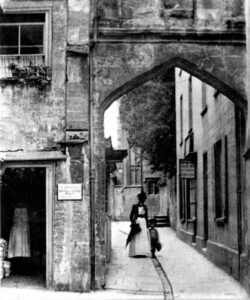
Alberta (also known as Albertina) Beatrice Gartell (1867-1940) was born at Church Lane, Sherborne on 12 January 1867 to Joseph Ridout Gartell (1827-1899) and Matilda (née Brown) (1827-1888). Alberta’s elder sister, Louisa Charlotte Gartell (1853-1940). worked as housekeeper for their father who ran a china shop at the Abbey Gate House in Church Lane, and Alberta was employed as a governess specialising in teaching English and music.
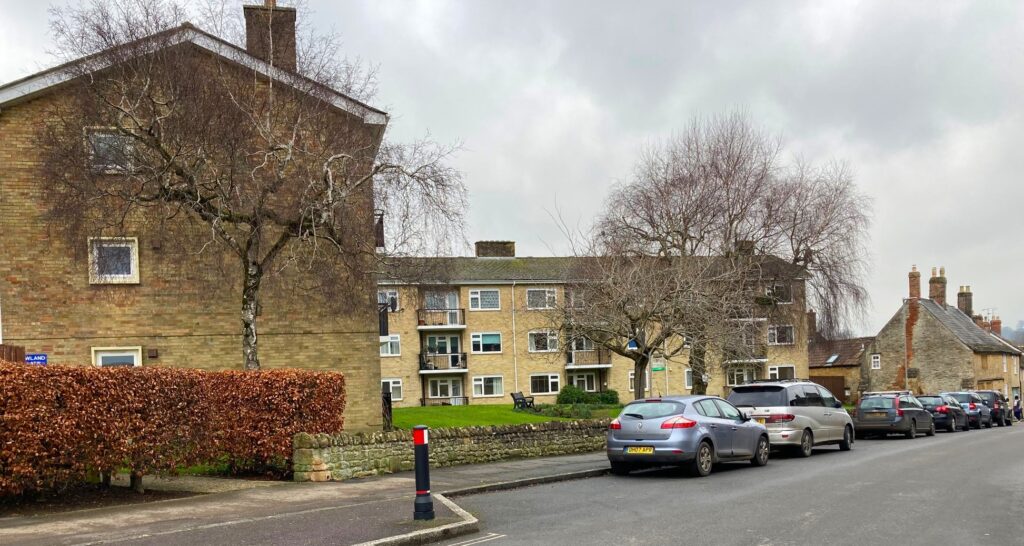
By 1901, Alberta and Louisa Gartell were sharing a cottage in Lower Newland, Sherborne, next-door to Foster’s Infant School.
While living at Romany Cottage at Silverlake near Sherborne, the author Monica Hutchings became friends with Alberta Gartell, and in her book Romany Cottage, Silverlake (1946) she describes the interior of Alberta’s cottage:
‘Her house was like a museum, filled with books and curios, old pieces of furniture, nick-nacks and odds and ends. Never have I seen such a collection in a private dwelling. But all her treasures were lumped together with a fine disregard for taste or arrangement and intermingled with her personal effects and clothes and food, so that the result was like a jumble sale.’
Monica goes on to say that the sound of the air raid sirens during the Second World War made Alberta very nervous and so on 1 October 1940, the day after the bombing of Sherborne, she visited Alberta but was shocked to find that her cottage in Lower Newland was just a pile of rubble. Later that day an evacuee told Monica she had just seen Alberta’s body being removed from the remains of her cottage. On making her way to the town’s cemetery in Lenthay Road, where the chapel of rest was being used as a temporary mortuary, Monica was asked to identify Alberta’s body:
‘The kindly constable assured me that everything pointed to Miss Gartell having died instantly. And I found no cause to dispute it. Shock and terror were plain on her features, and she was absolutely unmarked. She had plainly died of blast or else shock. I was glad no one else who was closer to her than I, had to see the expression on her face.’
Alberta’s funeral was held at Sherborne on 5 October 1940, although she was buried away from Sherborne.
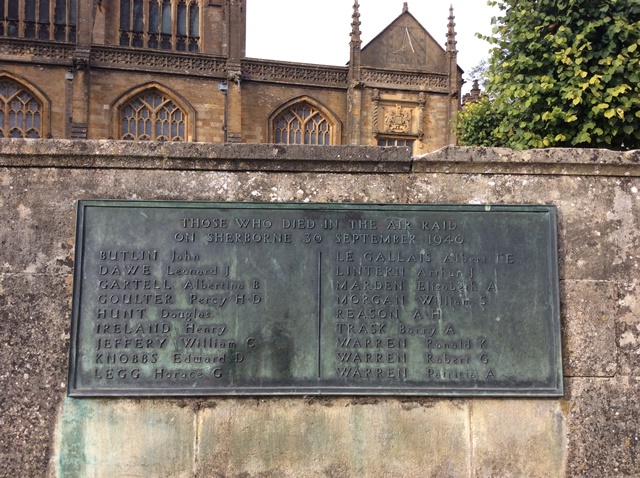
Alberta Gartell is remembered on the Civilian War Memorial in Half Moon Street, Sherborne, and also on the roll of honour in the Lady Chapel of Sherborne Abbey.
Although Alberta’s sister Louisa was not injured during the bombing of Sherborne, she died shortly afterwards on 2 October 1940 at 8, Damers Road, Dorchester. It was said that she died from shock.
The Newland area of Sherborne was badly damaged during the bombing of Sherborne on 30 September 1940. The bomb that destroyed Alberta’s home also destroyed Foster’s Infants School, but thankfully the school day had ended a quarter of an hour before the bombing and the children had all left. Alberta’s next-door neighbour Albert Henry Reason (1890-1946) was seriously injured during the bombing, but never fully recovered and died at ‘Ellington’ in Long Street on the 4 April 1946, aged 55.
Rachel Hassall
20 September 2025
See also:
- Maude Steele GM (1901-1997): awarded the George Medal for her bravery during the bombing of Sherborne
- Elizabeth Marden (1865-1940): town nurse and civilian casualty of the bombing of Sherborne
- Annie Warren (1909-2004): lost 3 children in the Sherborne Blitz
- Civilian casualties of the bombing of Sherborne on 30 September 1940
- Margaret Hayter (1923-1943): only Commonwealth War Grave to a woman who died on service in World War Two
- Monica Hutchings (1917-1977): author and campaigner
- Margaret Billinger (1883-1942): Headmistress of Lord Digby’s School 1917-1942