In the Commonwealth War Grave section of Sherborne Cemetery can be found the only war grave in Sherborne to commemorate a woman who died on service during the First World War.
The grave belongs to Dorothy Stacey (1893-1918) (1923-1943), and the inscription on her headstone reads:
2/R/S/519 STAFF NURSE
D.L. STACEY
Q.A. IMP. MIL. NURSING S.C.E.
5TH OCTOBER 1918, AGED 25.
‘SHE HATH DONE WHAT SHE COULD’
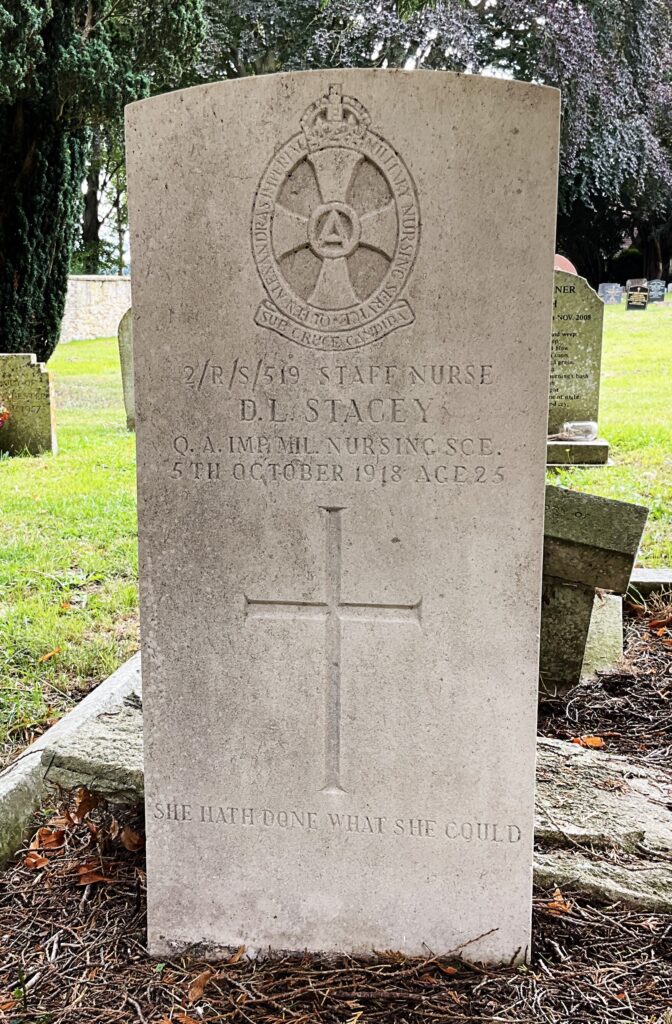
Dorothy Louise Stacey (1893-1918) was born on 23 July 1893 at Charlton Horethorne, Somerset, and baptised in the parish church on 13 August 1893. Dorothy’s parents, Alfred John Stacey (1862-1928) and Mary Matilda Stacey (née Corry), farmed at Middle Farm, Charlton Horethorne, where on 18 February 1901 Dorothy’s younger sister Mollie Kathleen Stacey (1901-1974) was born. The family later moved to The Black House at Letton, Herefordshire.
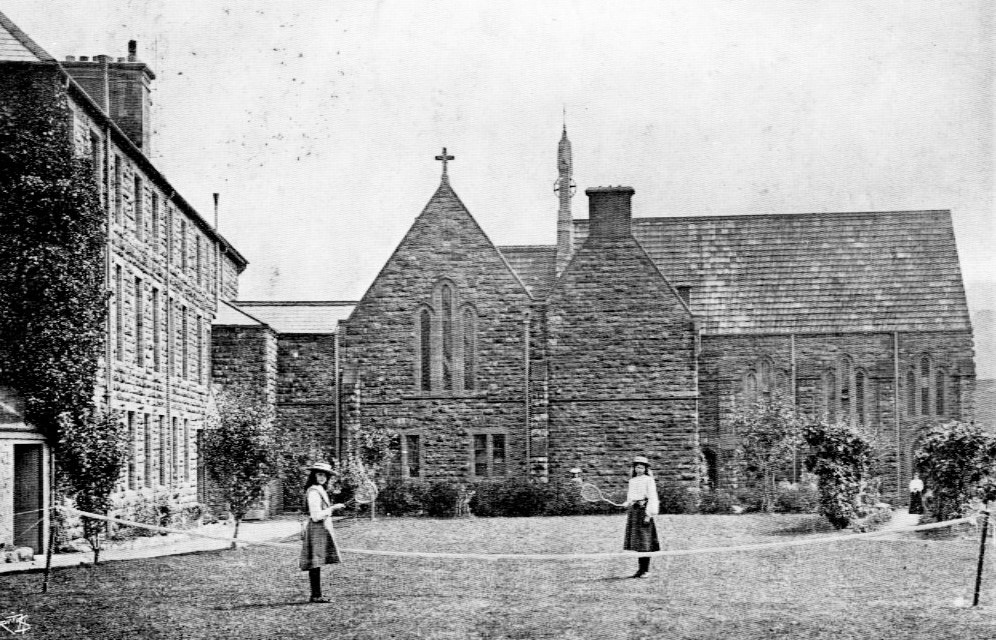
Dorothy was educated at St Antony’s Convent School in Westbury, Sherborne, a Roman Catholic school opened in 1891 by nuns of the Religious of the Christian Instruction. In 1948 the school moved to Leweston Manor and it is now known as Leweston School.
From 1 July 1914 to 1 July 1917, Dorothy trained as a nurse at the Royal Surrey County Hospital at Guildford, Surrey.
On 19 May 1917 Dorothy applied to join Queen Alexandra’s Imperial Military Nursing Service Reserve. Queen Alexandra’s Imperial Military Nursing Service (QAIMNS) had been established by the War Office in March 1902, with a permanent reserve formed in 1908 to provide a pool of trained nurses. During the First World War QAIMNS served on every front in the campaign and around 200 Army nurses were killed on active service. Dorothy’s application was accepted on 29 August 1917 and Staff Nurse D.L. Stacey (Service no. S/R/S 519) was posted to the Military Hospital at Wareham, Dorset. This was probably Worgret Camp, a large military camp built in September 1914 on the outskirts of Wareham which included a hospital with 185 beds, a cinema, and a YMCA clubhouse. After the war the camp was closed and its operations were transferred to Bovington Camp, Dorset.
An insight into Dorothy’s character and professionalism is provided by a report written at Wareham on 2 February 1918 by the hospital’s Matron A.M. Elliot:
‘Staff Nurse Stacey has served under me in this Hospital from 29 August 1917 to the present date. Her professional ability is of standard rank; administrative capacity, good; power of initiative & ability to instruct & train orderlies, fair; is of good education, has good manners & bearing. Temper, very good; tack & judgment, fair; zeal, energy & reliability, excellent. Common-sense, punctuality, & influence, generally good. She has taken Sister’s duties in a medical ward from 19.12.17 with success; will be fitted for promotion when she has gained experience.’
However, on 17 October 1918, the Director General of the Army Medical Service wrote to Dorothy’s father informing him, ‘it is with deep regret that I have to inform you of a report having been received from the Military Hospital Wareham stating that Staff Nurse Miss Dorothy Louise Stacey, Queen Alexandra’s Imperial Military Nursing Service Reserve, died there on the 5th instant. I beg you will accept this expression of my sincere sympathy.’
A report on Dorothy’s death, written on 14 October 1918 by Captain Martin, R.A.M.C., Military Hospital, Wareham, reveals in distressing details Dorothy’s illness and the days leading up to her death:
‘Staff Nurse Miss Stacey was taken ill on the evening of September 22nd, 1918. On the morning of the 23rd September, her case was diagnosed as one of influenza. The disease followed a normal course: the chief symptoms being, moderate pyrexia, headache, a rather distressing cough, an acute laryngitis and a few moist rales at the base of the right lung, until the 28th September when there was a sharp rise of temperature to 105 F. On Monday morning the 30th of September she became markedly dyspnoeic and cyanosed. The physician Specialist was at once sent for and, after examination, pronounced the case to be one of purulent bronchitis. The urine contained a high percentage of albumen. From that date onwards until her death on the morning of the 5th October, 1918, she gradually grew worse in spite of hourly administrations of oxygen for 10-12 minutes, and other forms of treatment. A specimen of sputum which was sent for examination was unfortunately lost in transit, and hence no bacteriological report is available.’
Dorothy died on 5 October 1918, aged just 25 years old. Her death certificate records her cause of death as Purulent Bronchitis (12 days), Acute Nephritis (6 days), and Cardiac Failure.
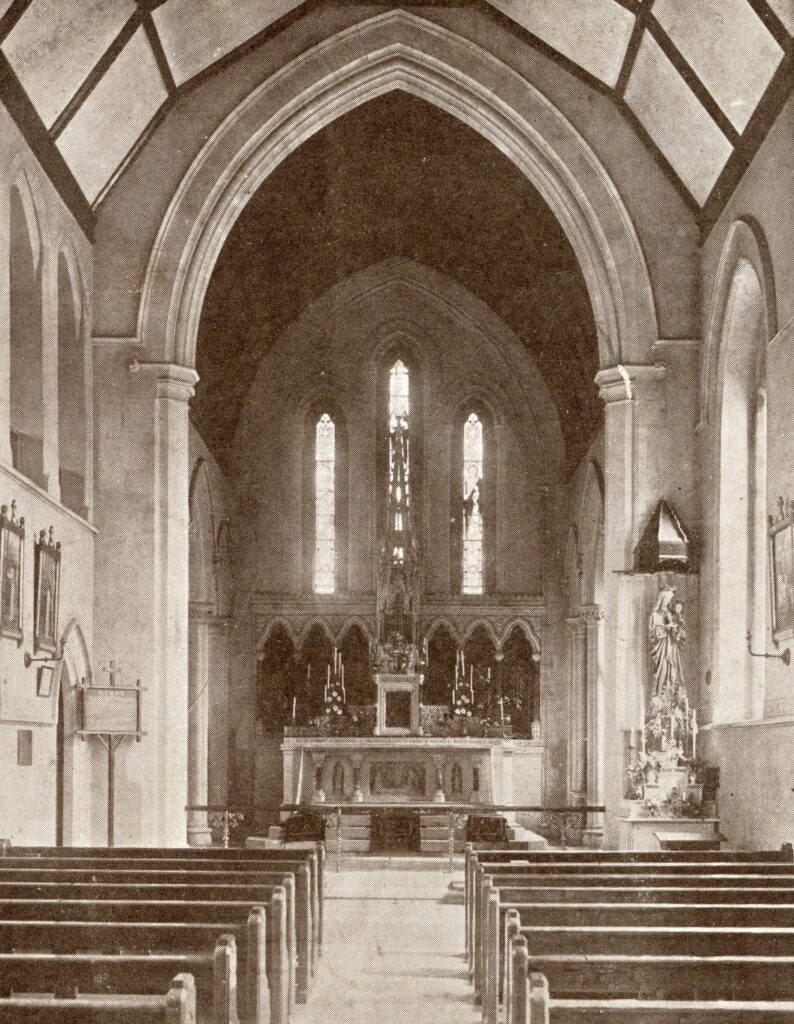
Dorothy’s funeral was held at Sherborne on 10 October 1918. Her body was brought to Sherborne from Wareham and placed in the chapel of her former school at the Convent of St Antony, where the first part of the service was held. She was buried in the south-east (Roman Catholic) sector of Sherborne cemetery (plot 17, grave 257), where her grave is marked with a Commonwealth War Grave headstone, and also a cross and curb.
The Western Gazette on 18 October 1918 included the following report of Dorothy’s funeral:
‘NURSING SISTER DIES ON SERVICE. The death occurred, at the Military Hospital, Wareham, on Saturday last week, after a brief illness, of Staff Sister D.L. Stacey, elder daughter of Mr and Mrs Alfred Stacey of Letton, Hereford, and late of Charlton Horethorne. The funeral took place at Sherborne Cemetery on Thursday last week, and was attended by a large number of relatives and friends. The remains had been brought from Wareham on Tuesday, and placed in the Convent of St Anthony, and the first part of the service on Thursday was held in the chapel of the Convent. The chief mourners included the bereaved parents and sister, Mr and Mrs H.J. Down, Mrs Corry, Messrs. D. and Bobbie Corry, Mr W. Stacey, Miss L. Stacey, Mrs Brook, Miss Horsington, Mr L. Phillips, and Miss Kathleen Phillips. Floral tributes were sent as follows: From her sorrowing parents and sisters; Uncle Bert and Auntie Kittie; Uncle Wm. Corry and family; Uncle Ted and auntie; uncle and aunts at Bratton; Auntie Emm, Poppy, Jack, and Dick; Auntie Lill, Auntie Alice, and Sydney; Uncle George and cousins; Mr and Mrs Jack Hutchings; Mr and Mrs J. Ryall; Dora; Mrs W. Down; nursing staff, Military Hospital, Wareham; the V.A.D.’s of general staff, Military Hospital, Wareham; the officers, R.A.M.C., Military Hospital, Wareham; Detachment; No.6 Company, R.A.M.C.; Mrs Morris, Wareham; and Mrs White, Wareham.’
Rachel Hassall
See also:
- Dorothy Louise Stacey’s grave in Sherborne Cemetery (FindaGrave)
- Commonwealth War Grave entry for Dorothy Louise Stacey (CWGC)
- Queen Alexandra’s Royal Army Nursing Corps (National Army Museum)
- Wareham in the First World War: No.1 Wareham/Worgret Camp
- St Antony’s Convent School and the Order of the Religious of the Christian Instruction
- Margaret Hayter (1923-1943): only Commonwealth War Grave to a woman who died on service in World War Two
- Elizabeth Marden (1865-1940): town nurse and civilian casualty of the bombing of Sherborne
- Alberta Gartell (1867-1940): civilian casualty of the bombing of Sherborne
- Maude Steele (1901-1997): awarded the George Medal for her bravery during the bombing of Sherborne