Margaret Millicent Billinger (1883-1942) was born on 30 June 1883 at 18, Cardiff Street, Aberdare, Glamorgan, daughter of James Fussell Billinger (1858-1928), a newsagent and railway bookstall manager, and Margaret Jane (née Thomas) (1857-1928).

By 1891, Margaret and her family were living at 11, Alfred Street, Neath, and by 1901 they were living at 11, Bay View Crescent, Swansea, where Margaret was admitted in January 1901 as a student at Swansea Teacher Training College.
In 1905, Margaret was appointed to her first teaching post as assistant mistress at King’s Lynn Pupil Teacher Centre in Norfolk. From 1907 to 1910 she was assistant mistress at Nuneaton County Secondary School and Pupil Teacher Centre in Warwickshire, and from 1910 to 1917 assistant mistress at Nuneaton High School for Girls, where she met her the woman who became her lifelong friend, fellow assistant mistress Kathleen Sparke (1886-1945).
By April 1912, Margaret’s parents were living at ‘Cartref’, St Barnabas Road, Cambridge, from where her younger sister Florence Maud Billinger (1886-1960) was married to James Arnold Crowther (1883-1950), a Fellow of St John’s College, Cambridge, at whose wedding Margaret was a bridesmaid. James was a physicist and later became chair of the physics department at the University of Reading and helped found the Institute of Physics.
Tragedy struck the Billinger family on 23 November 1916, when Margaret’s only brother Second Lieutenant Hector Fussell Billinger (1893-1916) was killed in action on the Somme. Hector had been educated at the Cambridge County School and at St John’s College, Cambridge, and at the outbreak of war had been appointed history master at the Royal Masonic School in Bushey, Hertfordshire.
In July 1917, Margaret was appointed headmistress of Lord Digby’s School in Sherborne, where she succeeded Miss Ellen Ida Pearson Ashwell (1879-1955) who left to become headmistress of Blackburn House, Liverpool Institute High School for Girls.
Lord Digby’s School had relocated in 1898 from its original home at Foundation House in Westbury (now the Britannia Inn), to a property in Newland formerly occupied by St Swithin’s Laundry (now the site of Waitrose car park). In 1931 Margaret oversaw the school’s move from this site to Sherborne House (now The Sherborne).
Margaret was joined at Lord Digby’s School in 1918 by her friend Kathleen Sparke (1886-1945). Kathleen Mary Sparke was born on 26 May 1886 at Bank Head House, Hexham, Northumberland, daughter of John Sparke (1853-1933), a grocer and provision merchant, and Mary Ann (née Potts) (1852-1950). She had trained at Bedford Kindergarten College, and, after a brief stint as assistant mistress at a kindergarten and preparatory school in Gosforth, Newcastle-on-Tyne, was appointed assistant mistress at the High School for Girls in Nuneaton, where she taught from 1913 to 1917.

After Kathleen’s move to Sherborne she and Margaret lived at Ransome House (also known as Ransam House) on Greenhill, Sherborne, where Margaret ran a boarding house for the girls at Lord Digby’s School and Kathleen set up the school’s preparatory department. The house had previously been used as a boarding house for Sherborne School and later became the first home of Sherborne School for Girls.
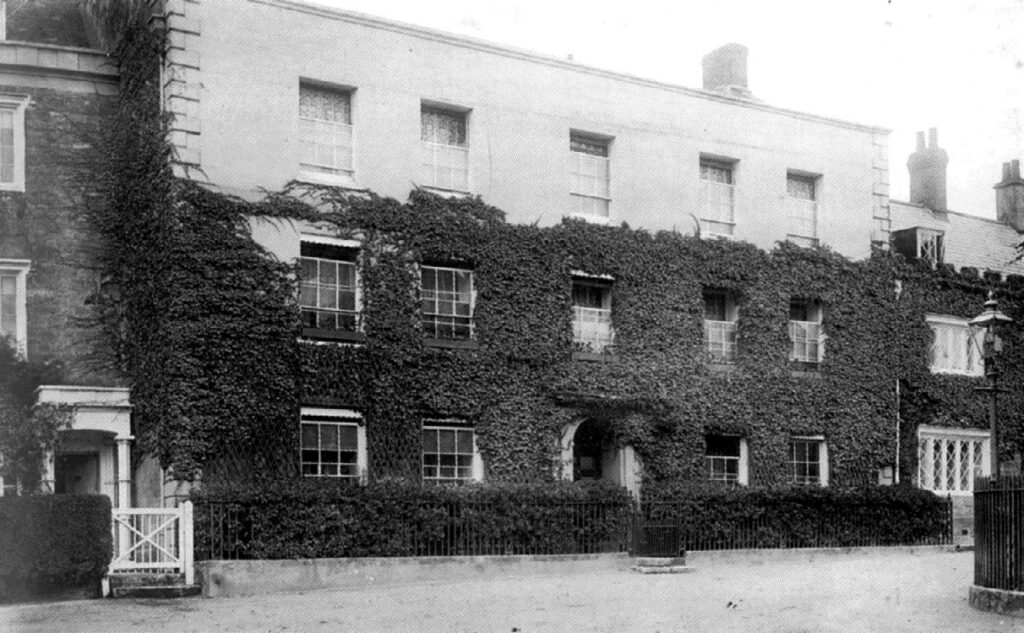
When the lease of Ransome House expired in 1924, Margaret and Kathleen jointly purchased Englefield (which they renamed Stonegarth) in The Avenue, opening it in September 1924 as a boarding house for Lord Digby’s School. From 1925 to 1945 Kathleen ran a preparatory school in the adjoining property Little Stonegarth.
Margaret was a popular headmistress, and in July 1938 the Old Girls’ Association celebrated her 21st anniversary as headmistress of the school, presenting her with a bouquet of pink carnations tied with a ribbon in the school colours, a cheque for £10 10s., and a book of remembrance containing the names of the subscribers (printed and illuminated by Lily Clothier). With the cheque, Margaret bought herself a writing table, a reproduction of one used by Mary, Queen of Scots.
In 1929, Margaret and Kathleen had moved out of Stonegarth into Stonegarth Cottage next door, where they lived happily until the afternoon of 30 September 1940, when the cottage received a direct hit during a bombing raid. Fortunately, the cottage was held together by its chimney which allowed Miss Billinger to survive the blast during which she had been taking a bath.
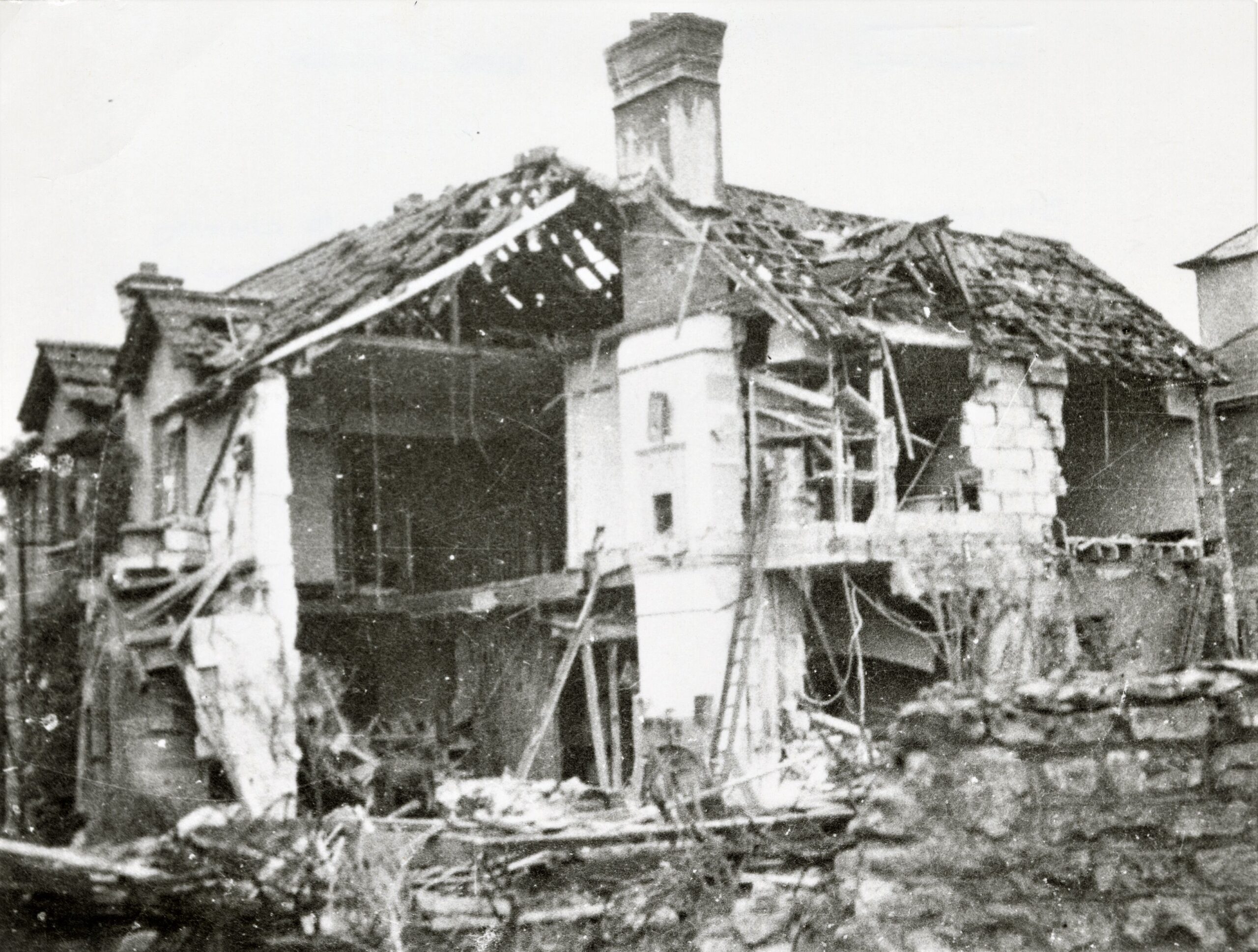
As part of Sherborne Museum’s Make Do & Mend project the curator Judy Nash recorded the memories of Nora Oxford (née Northover) who was a pupil at Lord Digby’s School in September 1940:
‘I was at the Lord Digby’s School boarding house at Sherborne, Dorset. I was 13, almost 14 and was a weekly boarder. My home was at Bishops Caundle so I stayed at the boarding house at Stonegarth at the bottom of The Avenue in Sherborne during the week and went home at weekends. On the 30th September 1940 we had finished school at Sherborne House and had walked back to the boarding house. We had gone to change for our afternoon walk before tea but the sirens had gone and we had to go to the cellar where our shelter was. This was where the food was cooked and they had a winch that pulled the food up to the first floor. The bombs started falling to the West of the town on Lenthay Common about 4.15 – 4.20 – I know we would have gone for our walk at 4.30. Every day we had to walk from Sherborne House in crocodile along Newland to Stonegarth and take off our uniform – quite a long walk and I remember we were getting changed when the sirens started. We heard the bombs coming down and getting closer and closer. One screamed down and we thought it was going to hit us but it hit our Headteacher Miss Billinger’s house, Stonegarth Cottage, next door. My dear friend Phyllis and I were some of the first people to go outside after it was all over. Next door Miss Billinger’s bath was hanging out of the wall. She had been having a bath. We found her across the road at Miss Dew’s and Miss Whitworth’s house, other teachers. Miss Billinger was wrapped in a blanket and was covered in dust and plaster. She only lived 18 months afterwards. I am sure it affected her life. As we walked out down our little short drive tiles fell off of Stonegarth and one clipped my ankle. I had a scar – the only school child scarred in the bombing raid! Newland Infants School, a short distance away received a direct hit. Fortunately the children had gone home. So had the Gartell’s cottage next to it. The Gartells had once had a china shop where the museum is now at Abbey Gate House. At Newland deliveries from the station were being made by carters with shire horses. The carter wasn’t hurt but the horse was killed by shrapnel.’
The bombing raid also left the neighbouring girls’ boarding house temporarily uninhabitable and the boarders were moved to billets around the town. A new boarding house was later found at The Wilderness in St Swithin’s Road, allowing Margaret and Kathleen to move back into Stonegarth, where Margaret died on 4 March 1942. Her cause of death was certified as carcinoma of breast by Dr Gerald Rickett who lived at Hill House in The Avenue.
By her last will and testament made on 28 February 1942, Margaret appointed Kathleen Mary Sparke of Stonegarth, spinster, to be executrix and trustee of her will. She left the following bequests:
- Faith Dew of Overdale, Sherborne – £50.
- Marjorie Whitworth of Overdale, Sherborne – £20.
- Mabel Wickham of Lord Digby’s School – £20.
- Margaret Williams of Lord Digby’s School – £20.
- Marjorie Rogers of Lord Digby’s School – £20.
- Maureen Palmer of Lord Digby’s School – £20.
- Mrs Mabel Embleton Upshall of 42, Simon’s Road, Sherborne – £10.
- Governors of Lord Digby’s School – £100 – to be spent in any way in which the Headmistress desires.
To Kathleen Margaret left all her personal chattels and effects, including her half share of ‘all motor cards and accessories, garden effects, domestic animals, plate, plated articles, linen, china, glass, books, pictures, prints, furniture, jewellery, articles of household or personal use or ornament, musical and scientific instruments and apparatus, wines, liquors and consumable stores’, which she owned jointly with Kathleen. The residue of her property she divided between Kathleen and her sisters Emma Rosaline Ross (wife of Henry Alford Ross of 5 Blanquetts Avenue, Worcester) and Florence Maud Crowther (wife of James Arnold Crowther of 18 Redlands Road, Reading). At probate, Margaret’s effects were valued at £5756 3s. 8d.

Margaret was buried in Sherborne Cemetery on 6 March 1942, where her headstone reads:
‘MARGARET M. BILLINGER
1883-1942
HEADMISTRESS OF
LORD DIGBY’S SCHOOL
1917-1942
The greatest of these is Love.’
The following account of Margaret’s funeral appeared in the Western Gazette on 13 March 1942 under the heading ‘HEADMISTRESS FOR 25 YEARS. DEATH OF MISS M.M. BILLINGER’:
‘She came to Sherborne as headmistress of Lord Digby’s School in July 1917, and her passing will be widely mourned. Her interests were wide, and her sympathies freely enlisted for any cause she considered deserving. She was a member, and had served on the Committee of the West of England branch of the Headmistresses’ Association. She was also secretary of Sherborne branch of the Church Missionary Society, and was very proud that several of her girls grew up to be missionaries. One is in India and another in South Africa. There was a large congregation at the funeral service at Sherborne Abbey on Friday, prior to the interment at the Cemetery. There were representatives of the governing body, mistresses, old girls and the elder scholars of the School, as well as of the townspeople. The Vicar (Canon J.P.W. Lovett) officiated, assisted by the Rev. Arthur Field, a Governor of the School. The hymn ‘Praise my soul the King of Heaven’ was sung, and Mr W.E. Wearden was at the organ. The only flowers were a cross of daffodils and bunches of wild snowdrops from the girls. Principal mourners were Mrs H. Rees (Uppingham) and Dr and Mrs A. Crowther (Reading), brother-in-law and sisters. Among the Governors present were Mr W. Henning (chairman), Mr Littleton Powys, Miss H.V. Stuart (headmistress of Sherborne School for Girls), Mrs Carey and Miss Ainslie, and Captain W.A. Ffooks (clerk to the governing body). The County Education Authorities were represented by Miss Miller. Mr Meredith Thomas, one of the School Governors, was unable to attend.’
This account was accompanied by ‘An Appreciation’ by Littleton Charles Powys, for many years Chairman of the Governors of the School and formerly headmaster of Sherborne Prep School:
‘Lord Digby’s School has suffered a grievous loss. Those who remember what the School was when Miss Billinger was appointed and see what it is now, will realise the enormous progress which has been made during the 25 years of her life, which were whole-heartedly devoted to its welfare. This success was due firstly to her intense faith in her profession and in the value of secondary education, and to the enthusiasm with which she did everything in her power to send girls out into the world, having learnt how to find joy in a world so intensely interesting. Secondly, it was due to a hopefulness that was ever strong within her. When after the Governors had decided that they could no longer be responsible for a boarding house, she boldly and hopefully bought a house, equipped it herself, and at great personal sacrifice for 15 years or more ran it with the greatest efficiency to the utmost benefit of the girls under her charge and of the school itself. Again, when year after year passed and it seemed that we should never be allowed to enter the promised land of Sherborne House she never gave up hope, and her courage was rewarded on 9th November 1931. Thirdly, it was due, of this I was sure, to the kindness of her heart, that greatest of God’s gifts. No one could visit the School without being conscious of its happy atmosphere. The Assistant Mistresses and the girls alike knew that they had a leader whose affection for them was such that there was nothing that she would not do for their welfare; that in her they had one who would guide them, would encourage them, would bear with them, would forgive them, and would rejoice with them; and to this kindness of heart they one and all responded. How could she not succeed with faith, hope and above all charity in constant attendance up on her?’

Kathleen Mary Sparke died on 12 September 1945 at 16, Elvaston Road, Hexham, Northumberland. An inquest recorded her cause of death as ‘natural causes, coronary artery thrombosis.’
In 1946, some books from Margaret and Kathleen’s collection at Stonegarth were given to Lord Digby’s School library, with the remainder, mostly English texts and commentaries, being sent to an International School in Holland run by the Society of Friends which had been destroyed during the Second World War. It was felt that this was a fitting continuation of Margaret’s work for international understanding and co-operation.
Margaret Billinger was succeeded as Headmistress of Lord Digby’s School by Miss Helen Cecilia Thomson (1902-1996), author of Lord Digby’s School: Some Aspects of Its History (Sherborne: The Abbey Press, 1969).
Headmistresses of Lord Digby’s School
(?) Mary Gaylard
1770 Mary Bishop
1770 Frances Soper
1774 Eleanor Gaylard
1808 Ann Longman
1812 Ann Noake (1770-1864)
1851 Sophia Jane Hughes (1818-1880)
1855 Theodosia Thomas
1856 Priscilla Brett (c.1815-1867)
1867 Mrs Mary Kenerston (née Noel) (1839-1896)
1885 Harriet Sophie Clarke (1846-1926)
1905 Susie Ellen Duxfield (1883-1962
1911 Ellen Ida Pearson (1879-1955)
1917 Margaret Millicent Billinger (1883-1942)
1942 Helen Cecilia Thomson (1902-1996)
1967 Mrs Monica Jane Fellowes Ditmas (née Richardson) (b.1924)
1979 Shelagh Mary Hill
Rachel Hassall
Further reading:
Barbara Elsmore (ed.), Looking Back at Lord Digby’s School (Lord Digby’s School Old Girls’ Society in association with Sherborne Museum, 2014)
Shelagh M. Hill, Sherborne House and its people (Dorchester, 1996)
H.C. Thomson, Lord Digby’s School: Some Aspects of Its History (The Abbey Press, Sherborne, 1969)
Friends of Sherborne House, ‘Short History’ (accessed 12 August 2024)
See also: