The case of Miles v. Magan for breach of promise of marriage was scheduled to be held at the Bristol Assizes on 18 August 1858. With the defendant named as the member of parliament for Westmeath in Ireland, damages laid at £10,000 and some hundreds of love letters ready to be produced as evidence, the case not surprisingly attracted a great deal of interest in both the local and national press.[1]
The defendant in the case was Captain William Henry Magan (1819-1861), MP, of Clonearl, County Offaly,[2] and the plaintiff was Miss Ellen Miles (1828-1872), daughter of William Miles (1790-1868), a Sherborne fishmonger.
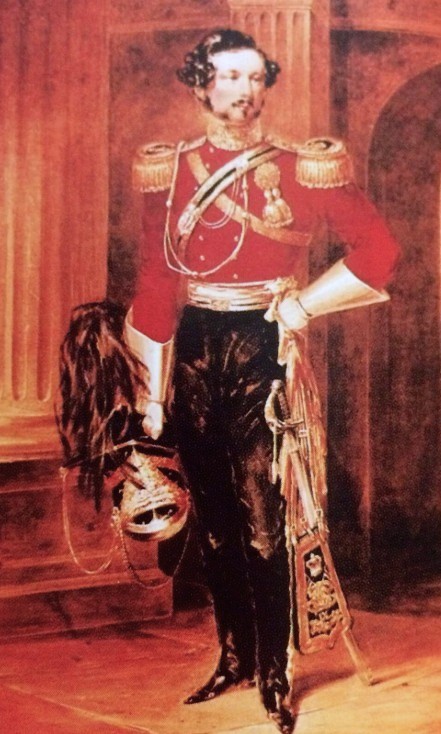
The press coverage reported that while working as a shop assistant at the Swan and Edgar department store at Piccadilly Circus in London, Ellen Miles caught the eye of Captain Magan when he accompanied his widowed mother to the store to purchase a shawl. Captain Magan allegedly asked Ellen, who was ‘reputed to possess great personal attractions’,[3] to model the shawl for his mother but returned later to buy the shawl as a present for Ellen.[4] There then followed a lengthy correspondence between Captain Magan and his ‘dear Nelly’, during the course of which Ellen believed Captain Magan made her a promise of marriage.
The course of true love did not run smoothly and in August 1858 Ellen brought an action for breach of promise of marriage against Captain Magan. With the press having ‘whetted the public appetite for several days with anticipatory allusions to the wealth of the bridegroom, the beauty of the bride, and the long array of love letters’,[5] not surprisingly when the case came to court on 18 August 1858 the viewing gallery at the Bristol Assize court was packed. The disappointment of the viewing public must have been palpable when moments before the case was due to be heard it was settled out of court with Captain Magan agreeing to pay Ellen the sizeable sum of £2,000, equivalent to over £200,000 today,[6] in exchange for the return of all the love letters and also of a portrait of himself. The agreement also stated that all copies of the love letters made for the purposes of the case were to be destroyed. In return, Captain Magan stated that there was not the slightest imputation on Ellen’s character as regards her purity and virtue.[7]
Surprisingly, this was not the end of Captain Magan and Ellen’s love story and just three years later they were married at Yeovil. Their story, however, seems to have been fated because two months’ later, while on honeymoon at Weymouth, Captain Magan died.
On first discovering the story of Captain Magan and Ellen Miles I was inclined to feel sorry for Ellen, the beautiful yet innocent daughter of a Sherborne fishmonger who had been taken advantage of by a wealthy man of the world. But on researching their story further I began to wonder whether Ellen was not in fact the victim but the protagonist of the story. Might Ellen have cunningly made full use of her ‘natural charms’ to provide herself with a financially secure and comfortable future?
So, who was Ellen Miles?
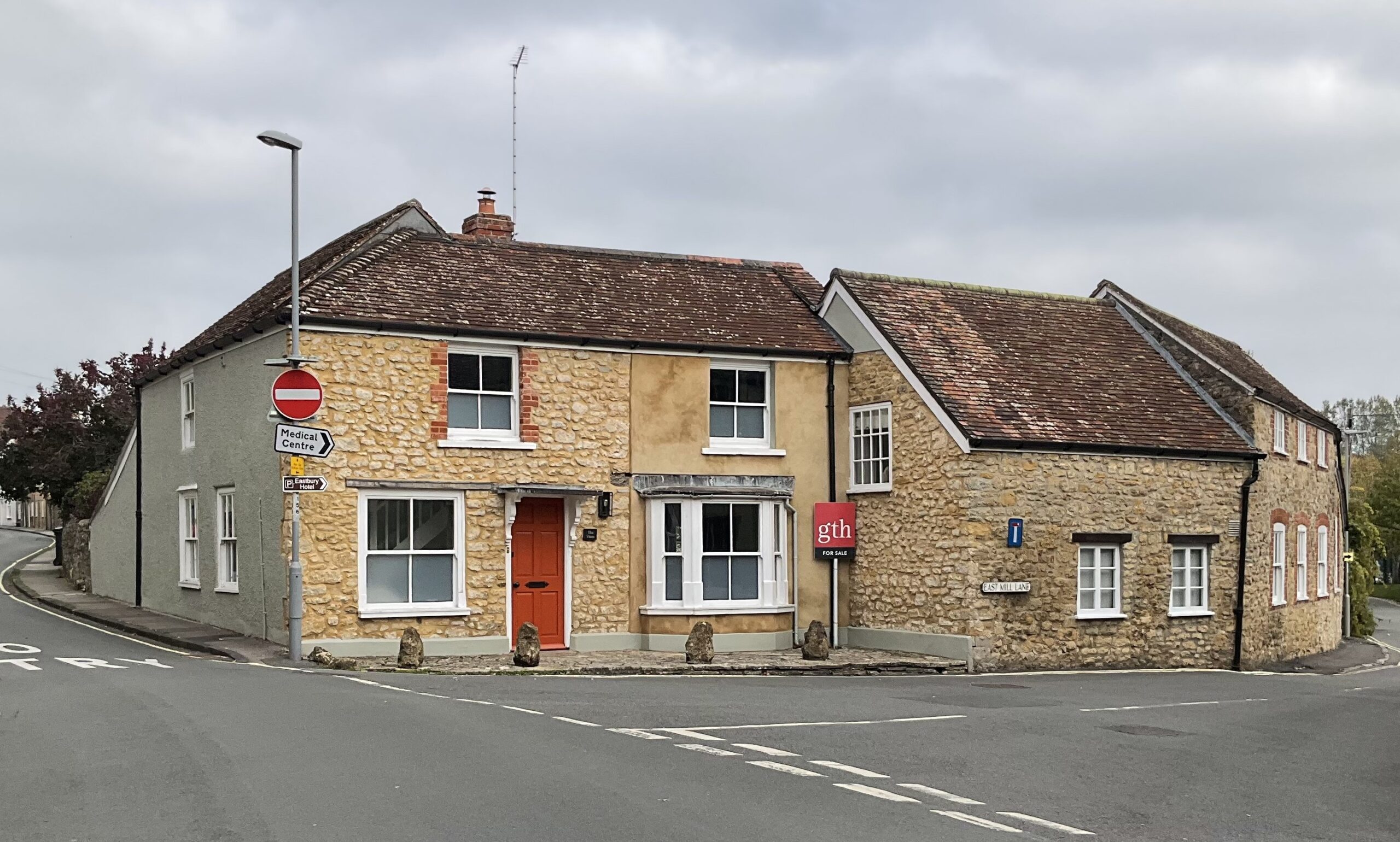
Ellen was born at Sherborne in about 1828, one of eleven children[8] born to William Miles (1790-1868) and Sarah (née Hamilton) (1786-1865) who ran a fishmonger’s business from their home at The Vines in Long Street, Sherborne.
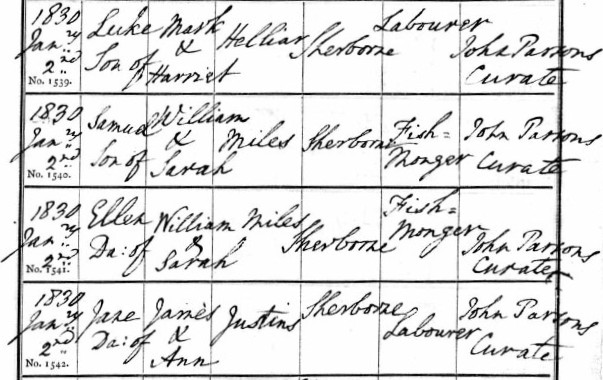
Ellen and her elder brother Samuel Miles (1827-1896) were baptised together in Sherborne Abbey on 2 January 1830 by the Rev. John Parson,[9] the same day as their three-month-old sister Emma Miles (1829-1830) was buried.[10]
Following her baptism Ellen disappears from the official record, only to reappear 21 years later in the 1851 census[11] when she was visiting her brother Samuel and his wife Anna (née Foot) (1830-1878) at 21, Bennett Street, Southwark, where Samuel was employed in the family business as a fish salesman. Curiously, Ellen gives her occupation as ‘annuitant’, i.e. the beneficiary of an annual payment. I have been unable to find out from whom Ellen received this payment but wonder whether as the youngest surviving child of a large family she may have been unofficially adopted by a wealthy childless couple?
Despite having an annuity, we know from the Bristol Assize court proceedings that by 1857 Ellen was working in London as a shop assistant at the Swan and Edgar department store in Piccadilly Circus[12] where Captain Magan was apparently impressed by her ‘elegant figure’.[13]
After this first meeting a lengthy correspondence apparently ensued between Captain Magan and his ‘dear Nelly’ which Ellen later threatened to produce as evidence in the breach of promise of marriage case. The correspondence amounted to several hundred letters which when printed for the use of Ellen’s counsel formed ‘a quarto volume of 198 closely printed pages.’[14] Had Ellen kept Captain Magan’s love letters for romantic reasons or was she astute enough to realise they might be a valuable bargaining tool? With Captain Magan agreeing to a sizeable out of court settlement for their return it suggests Ellen was not blind to their potential monetary value.
When Ellen met Captain Magan in 1857 she cannot have been totally unaware of his reputation. Known as William Henry Magan ‘the bad’,[15] following the death of his father in May 1840 he came into an enormous inheritance with mansions at Clonearl in Co. Offaly and Killyon Manor in Co. Meath, a town house in Dublin, and vast estates in Ireland. Educated at Trinity College, Dublin, in February 1841 he entered the army purchasing the rank of Cornet in the 9th Lancers,[16] in September 1842 he obtained by exchange the rank of Lieutenant in the 4th Light Dragoons[17] and in 1845 he purchased a promotion to the rank of Captain.[18]
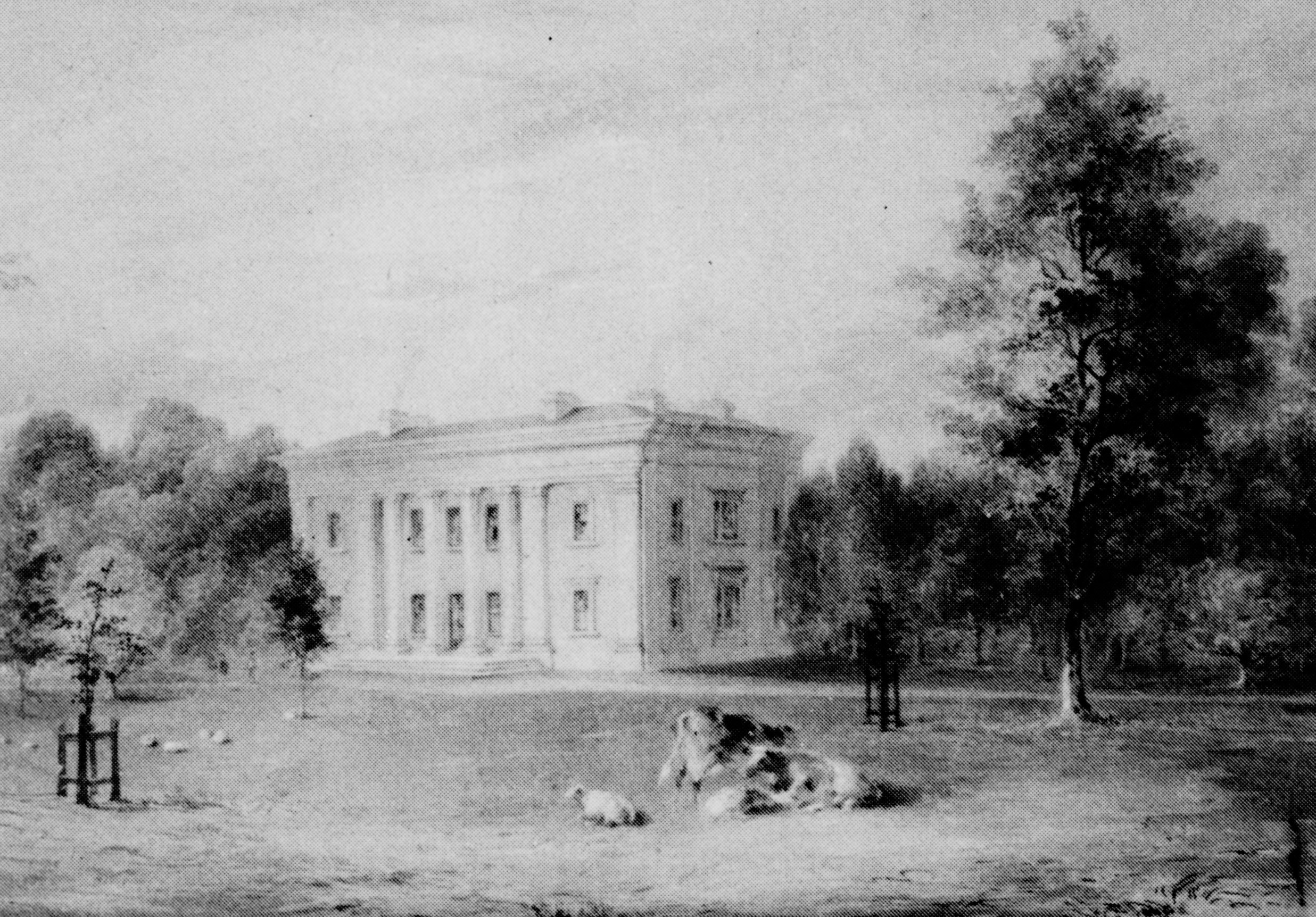
Apart from time possibly spent in South Wales in 1843 when the 4th Dragoons were engaged assisting to put down the ‘Rebecca Riots’,[19] Magan’s army career appears to have been largely uneventful with him spending much of his time organising horse races and drinking heavily. He earned his nickname ‘the bad’ because of the numerous unpleasant exploits in which he was involved, including a particularly unpleasant incident when for fun a beggar was tarred and feathered and set on fire.[20]
Magan’s notoriety was further increased in 1845 when Lady Georgiana Keppel (1806-1854)[21], daughter of the 4th Earl of Albermarle, left her husband and their ten children and moved in with Captain Magan at Clonearl. The ensuing divorce case led to further revelations about Captain Magan’s immoral conduct which included summoning his valet to witness him committing adultery with Lady Georgiana.[22] Following the annulment of her marriage in August 1849, Lady Georgiana and Captain Magan were married at St Margaret’s, Westminster but sadly just 4½ years later on 30 March 1854 Lady Georgiana died unexpectedly at Clonearl, leaving Captain Magan a widower at the age of 35.[23]
Three years after Lady Georgiana’s death Captain Magan first set eyes on Ellen Miles in Swan and Edgar’s department store which resulted in her bringing the breach of promise of marriage action against him in August 1858. The following year Captain Magan stepped down as MP for Westmeath[24] and thereafter his life began to spiral out of control, with stories appearing in the press of his eccentric and violent behaviour and increasing debts.[25]
How and when Ellen and Captain Magan rekindled their ‘romance’ is unknown.[26] After the breach of promise of marriage action in August 1858 Ellen again disappears from the official records, only to reappear three years later on 20 August 1861 when she personally applied to the Diocese of Bath and Wells for a marriage licence for her intended marriage to Captain Magan.[27] Ellen was again seizing the initiative, although with a drink problem and mounting debts Captain Magan was not the catch he had once been, but perhaps Ellen thought she could handle him and saw this as her opportunity for social advancement? Captain Magan may have hoped the marriage would produce a son and heir to inherit his estates. For both Ellen and Captain Magan, the marriage was probably one of convenience.
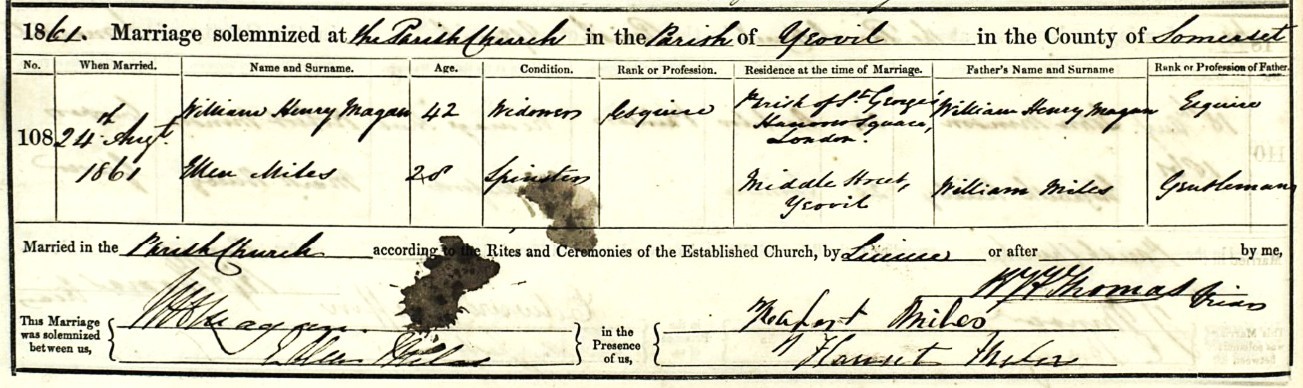
The marriage register for St John’s church, Yeovil records that on 24 August 1861[28] William Henry Magan, 42, widower, of the parish of St George, Hanover Square, Middlesex, was married by licence to Ellen Miles, 28, spinster, of Middle Street, Yeovil.[29] Surprisingly, the register describes Ellen’s father William Miles not as a fishmonger but as a gentleman! The witnesses at the wedding were Ellen’s brother Robert Miles (1823-1902) and his wife Harriet (née Herford) (1832-1893) who were then living in the Westbury area of Sherborne.[30] Two large ink blots on the marriage register beside Captain Magan’s signature suggest that the ceremony may not have been an entirely sober affair.
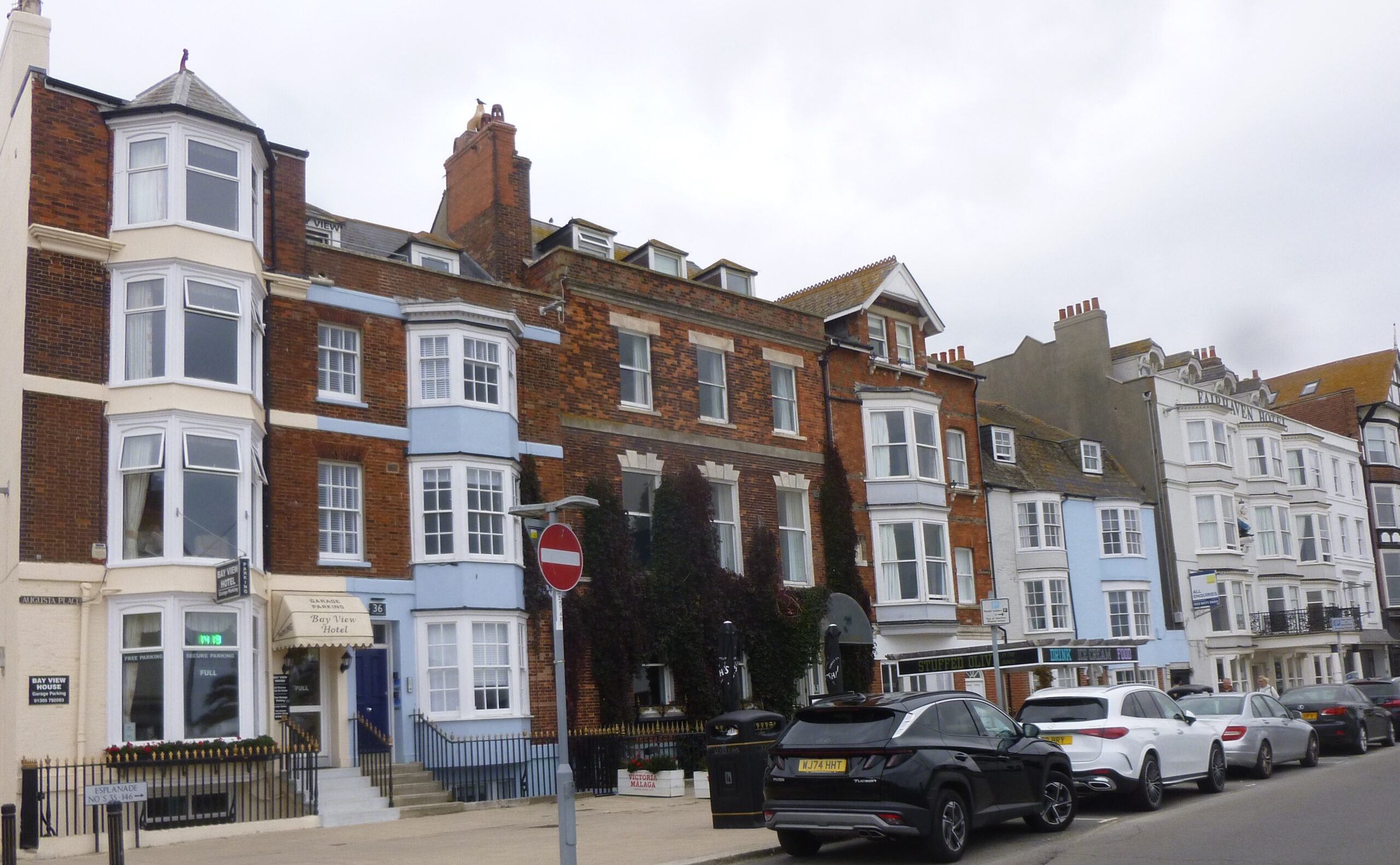
Following their marriage, Ellen and Captain Magan visited Sherborne where Captain Magan’s conduct ‘was certainly not that of a total abstainer’,[31] but Ellen was obviously keen to flaunt her catch. The happy couple then proceeded to Weymouth, staying at the Victoria Hotel on the Esplanade before moving a couple of doors away into private lodgings at Augusta Place.[32] It was here at Augusta Place that Captain Magan died on 24 October 1861, exactly two months after his marriage. The death certificate records that Ellen was present at his death, the cause of which was given as ‘Excess of drink. Exhaustion’.
Captain Magan’s body was conveyed from London to Kingstown (now Dún Laoghaire), Ireland on a royal mail steamer and interred in the Magan family crypt at St James’ church, Crinken, near Dublin.[33]
Widowed after just two months, Ellen was provided by the Magan estate with an annual income of £600,[34] equivalent to over £60,000 today,[35] making her independently wealthy and secure for life.
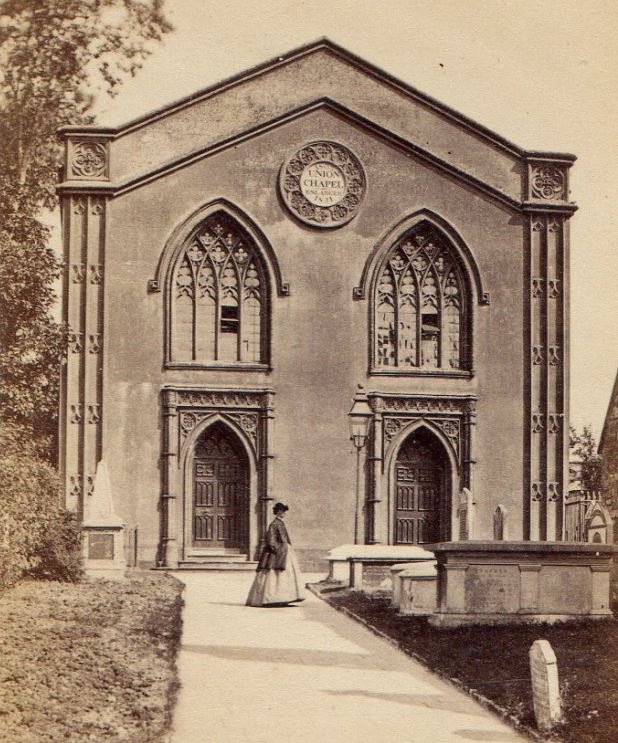
On 14 February 1865, Ellen’s mother Sarah Miles (1786-1865) died at The Vines, Long Street, Sherborne, aged 79, and was buried down the road at the Union Chapel in Long Street (now the home of Charterhouse Auctioneers).[36] On 7 April 1865, Ellen’s father made his will, appointing as his executors Thomas Moore of Yeovil, solicitor, and his son-in-law Felix Curtis of Yeovil, hairdresser. By his will he left to his eldest child Ann Miles (1810-1881) all his household furniture and stock in trade, together with The Vines (which was held on a lease from Earl Digby) and eight freehold cottages in Newland.[37] William died at The Vines on 4 December 1868, aged 82, he was buried with his wife at the Union Chapel in Long Street.
Quite how Ellen spent the remaining years of her life is a mystery, but by 2 April 1871 when the census was taken she was living the life of a respectable lady of means at 10, Kensington Gate, Chelsea, part of a group of elegant townhouses built in the Italianate style located just to the south of Kensington Palace – a far cry from the fishmonger’s shop in Sherborne.[38]
It is probable that Ellen moved between various properties depending on the season. By December 1872 she was living at 148, King’s Road, Brighton and it is here that she died on Christmas Day 1872. The death certificate records her cause of death as ‘Abdominal Tumour. Disease of Bladder’, suggesting she may also have developed a drink problem.
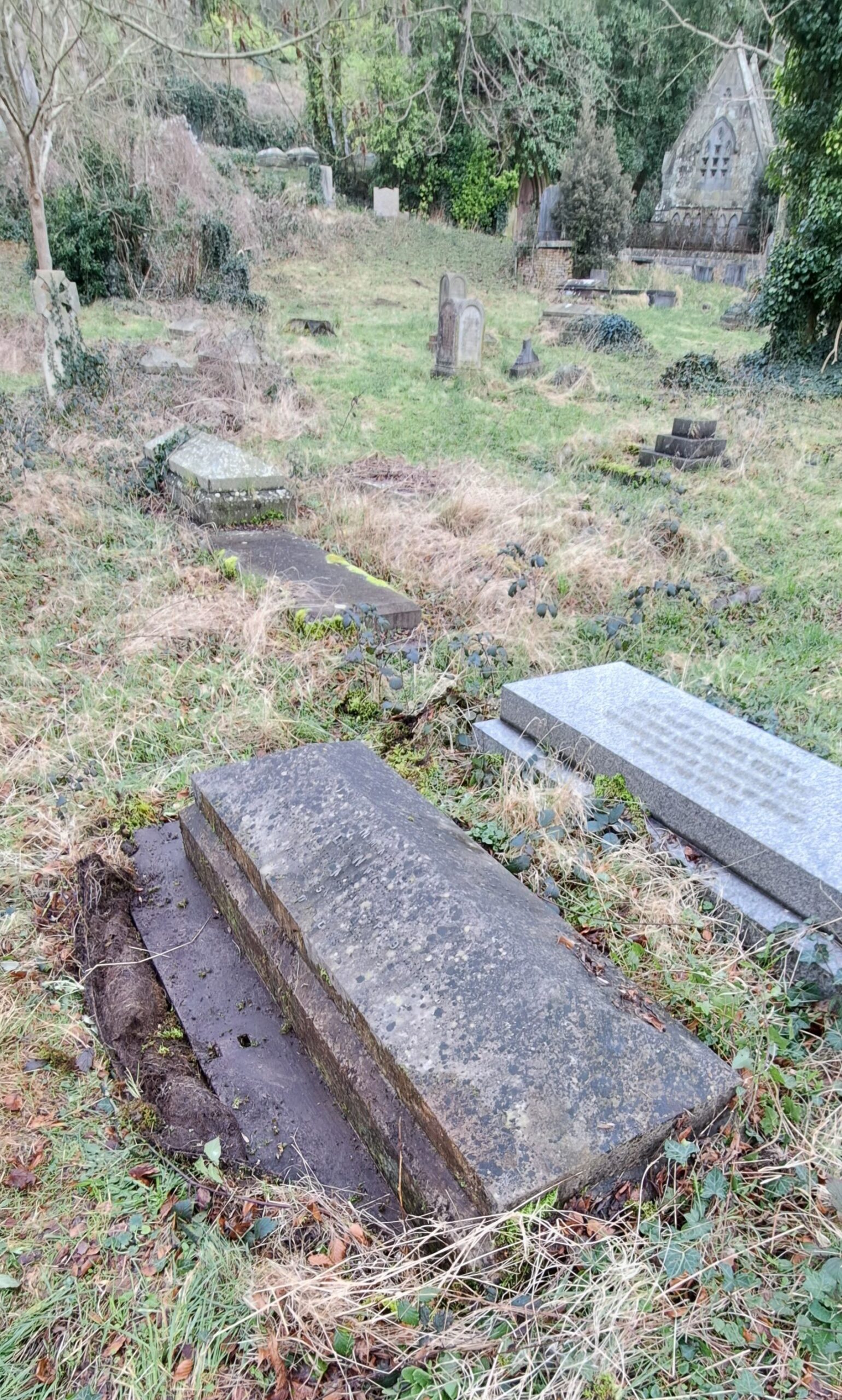
Ellen was buried on 30 December 1872 in the ‘Rookery’ section of the Extra-Mural Cemetery in Lewes Road, Brighton where the inscription on her gravestone reads ‘TEACH US TO NUMBER OUR DAYS THAT WE MAY APPLY OUR HEARTS UNTO WISDOM.’
Curiously, Ellen died intestate. Perhaps she had not realised the extent of her illness? Probate of her estate was granted to her sister Elizabeth Hann (née Miles) (1823-1882), wife of Cornelius Hann (1818-1893) of Yeovil. Ellen’s effects were valued at under £8000, the equivalent to £800,000 today.[39] Inevitably a dispute over Ellen’s estate ensued between her surviving siblings which resulted in a Chancery case in 1874.[40]
Sadly, Ellen has been written out of the Magan family history and does not feature in William Magan’s Umma-More. The Story of an Irish Family (1983). But, for me Ellen is the heroine of her own story. Using her brains and her beauty she ensured both social advancement and financial security and died a wealthy lady.
I have been unable to find a photograph or portrait of Ellen and would be delighted to hear from anyone who has one.
Rachel Hassall
24 December 2025.
A shorter version of this story was published under the title ‘An Irish MP and a Fishmonger’s Daughter’ in the SDFHS’s The Greenwood Tree, December 2025.
Footnotes:
[1] Among the newspapers that reported the breach of promise of marriage case were the Western Daily Press, 14 August 1858, Southern Times and Dorset County Herald, 21 August 1858, Sherborne Mercury, 24 August 1858, and the Manchester Courier, 28 August 1858.
[2] William Henry Magan (1819-1861) was born on 31 January 1819 at Rutland Square, Dublin, only son of William Henry Magan (1790-1840) and Elizabeth Georgina (née Loftus) (1795-1880). His sister Augusta Elizabeth Magan (1825-1905) was born in 1825.
[3] Southern Times and Dorset County Herald, 1858.
[4] ‘A dear shawl – the late breach of promise case’, Manchester Courier, 28 August 1858. A letter from Magan refuting this version of events was published in the Western Daily Press, 15 September 1858.
[5] ‘The story of William Magan and Ellen Miles. Strange Romance’, Western Daily Press, 1 November 1861.
[6] What cost £2,000.00 in 1858 would cost £216,782.80 in November 2025, Bank of England inflation calculator (accessed 24 December 2025).
[7] ‘The Great Breach of Promise Case’, Sherborne Mercury, 24 August 1858.
[8] The children of William Miles (1790-1868) and Sarah Miles (née Hamilton (1786-1865) were Ann Miles (1810-1881), William Miles (1812-1857), James Miles (1812-1812), Mary Miles (1814-1882), George Miles (1817-1857), Susan Miles (1818-1839), Elizabeth (Betsey) Miles (1823-1882), Robert Miles (1823-1902), Samuel Miles (1827-1896), Ellen Miles (1828-1872), Emma Miles (1829-1830).
[9] Dorset History Centre PE-SH/RE/1/1, Sherborne Parish register of baptisms, 2 January 1830.
[10] Emma Miles, daughter of William and Sarah Miles, was baptised at Sherborne on 24 October 1829 (DHC PE/SH RE 2/1) and buried at Sherborne on 2 January 1830, aged 3 months (DHC PE/SH RE 4/1).
[11] The 1851 census was taken in England on the night of Sunday, 30 March 1851. The 1851 census records living at 21, Bennett Street, Southwark, Samuel Miles, head, 25, fish salesman, born Sherborne, Dorset; Ann Miles, wife, 20, born Sherborne, Dorset; Ellen Miles, visitor, unmarried, 23, annuitant, born Sherborne, Dorset.
[12] The Swan & Edgar department store located at Piccadilly Circus, London. By 1848 the premises had expanded to 45–51 Regent Street and the entire corner of Piccadilly Circus. It later became Debenhams and closed in 1982.
[13] ‘A dear shawl – the late breach of promise case’, Manchester Courier, 28 August 1858.
[14] ‘The Sherborne Breach of Promise Case’, Southern Times and Dorset County Herald, 21 August 1858.
[15] William Magan, Umma-More. The Story of an Irish Family (Element Books Ltd., 1983), pp.270-285.
[16] ‘War Office, 5 February 1841’, Morning Post, 6 February 1841: ‘9th Regiment of Light Dragoons – William Henry Magan, Gent, to be Cornet, by purchase, vice Nicholson.’
[17] ‘War Office, 27 September 1842, Morning Post, 28 September 1842: ‘4th Regiment of Light Dragoons – Lieutenant William Henry Magan, from the 9th Light Dragoons, to be Lieutenant, vice Francis, who exchanges.’
[18] ‘War Office, 26 September 1845’, Morning Post, 27 September 1845: ‘4th Regiment of Light Dragoons – Lieutenant William Henry Magan to be Captain, by purchase, vice Parlby.’
[19] In July 1843 five troops of the 4th Dragoons were ordered to South Wales to assist the civil authorities in controlling the riots caused by ‘Rebecca and her Daughters’: ‘The Rebecca Riots 1843’, The Queen’s Royal Hussars Churchill’s Own website (accessed 23 December 2025).
[20] William Magan, Umma-More. The Story of an Irish Family (Element Books Ltd., 1983), p.273.
[21] Lady Georgiana Charlotte Keppel (1806-1854) was born on 15 July 1806 at Elvedon Hall, Suffolk, daughter of William Charles Keppel, 4th Earl of Albermarle (1772-1849) and Hon. Elizabeth Southwell (1776-1817). Queen Camilla is a descendant of Lady Georgiana’s brother George Thomas Keppel, 6th Earl of Albermarle (1799-1891). Lady Georgiana was married on 31 March 1827 to Captain Edward Eustace Hill (c.1799-1861) and during their marriage she gave birth to twelve children, ten of whom survived. On 4 January 1845 she left Captain Hill and moved in with Captain W.H. Magan at Clonearl. Her marriage to Captain Hill was annulled in August 1849.
[22] ‘House of Lords. Hill’s Divorce’, Morning Post, 30 July 1849. The newspaper includes a detailed account of Lord Brougham’s examination of Captain Magan’s valet James French.
[23] Lady Georgiana Magan (formerly Hill, née Keppel) (1806-1854) died suddenly in her room at Clonearl on the morning of Thursday 30 March 1854 while Captain Magan was in London engaged with his parliamentary duties. An inquest held on 3 April 1854 concluded she had died from natural causes, although her brain, heart, lungs and liver were found to be in a diseased state, while the pericardium pleura and the lining membrane of her stomach exhibited appearances of recent inflammation. Dr Glover stated he was medical attendant to the family and that due to her ladyship’s habits and state of health for a lengthened period such an event was not unexpected and he had warned her ladyship it was to be anticipated.
[24] ‘County Westmeath Election’, Westmeath Independent, 14 May 1859: ‘The nomination of candidates for the representation of this county in parliament took place on Tuesday last. The candidates up to Monday night were Sir Richard Levinge, Mr Pollard Urquhart, and Captain Magan. Intelligence, however, was received in town at an early hour on the morning of the nomination that Mr Magan had retired from the contest… Captain Magan did not make his appearance at the hustings.’
[25] It is possible that Captain Magan’s eccentric behaviour might have been inherited. His mother’s aunt, Martha Matilda Loftus was in 1838 described as a lunatic and his sister Augusta Elizabeth Magan (1825-1905) who inherited all the family estates died a recluse. A number of accounts of Captain Magan’s increasingly eccentric behaviour were reported in the press, including the following:
‘Extraordinary appearance of an ex-captain’, Downpatrick Recorder, 22 October 1859: ‘W. Henry Magan, an Irish gentleman, who gave his address 8, Gloucester Street, Belgrave Square, was charged on Saturday, at one of the London police offices, with being drunk, causing a disturbance in and around Scott’s oyster rooms, Coventry Street, and assaulting Alfred Mace, a waiter. Not only, as alleged, was the conduct of the defendant most remarkable on the occasion out of which the charge arose, but at the court during the investigation, and his appearance no less so. He wore a black dress coat, with a very gaudy necktie, in which the red greatly predominated; red and green plaid trousers, and patent leather boots. Over his arm he carried a deep red cloak, as an ex-Captain R.A., and besides a profusion of costly jewellery, he held in his hands a massive pair of gold bracelets, which, with one leg over the panel of the dock during the hearing of his case, by joining he converted for the nonce into what might be called a “policeman’s coronet,” by decorating with it, ceremoniously, the brows of Bendall, the gaoler, who stood beside him. Dangling from his wrist he carried a very showy ormolu trinket basket, lined with red silk, half filled with peppermint lozenges, which he from time to time distributed among the constables and those around him. The evidence was, that at midnight he planted himself in the doorway of Scott’s supper rooms, and as no one could pass in or out, the waiter respectfully requested him to move, upon which, seizing hold of him, he drew the back part of an open razor, which he pulled out, across his throat, much to the alarm of the waiter and those who were looking on, and then, as the complainant broke from him, struck him on the back with his gold headed stick. The waiter said he had ordered refreshment, and, after the assault, offered a considerable sum to “square it.” Fined £5 and to find sureties to keep the pace. The fine was soon paid, the bail produced and accepted, and the “illustrious stranger” departed with his friends. At a subsequent period of the day a gentleman in his carriage arrived at the court, and was much astonished to find that he had gone, having come expressly to take charge of him, and, if necessary, place him under proper restraint.’
[26] The case of Curlewis v. Magan, heard in the Chancery Courts in November 1861 and reported in the Western Daily Press, 16 November 1861, included a list of Captain Magan’s debtors including Henry C. Curlewis, tailor, Arthur Blücher Fores and Jane Amelia Fores, John Waller of Hampstead, trustee of Susannah Howell, W.H. Jones, E.R. Bremmidge, and also Ellen Miles for the sum of £1,687. Might Captain Magan have married Ellen Miles in order to clear the debt?
[27] Application for a marriage licence made to the Diocese of Bath and Wells on 20 August 1861: ‘appeared personally Ellen Miles of Yeovil in the County of Somerset, a spinster, of the age of twenty one years and upwards and prayed a Licence for the solemnization of matrimony, in the parish church of Yeovil in the county aforesaid and Diocese of Bath and Wells, between her and William Henry Magan of the parish of Saint George, Hanover Square, in the county of Middlesex, gentleman, and a widower of the age of twenty one years and upwards, and made oath that she believeth that there is no impediment of kindred or alliance, or of any other lawful cause, nor any suit commenced in an ecclesiastical court, to bar or hinder the proceedings of the said matrimony, according to the tenor of such licence. And she further made oath that she hath had her usual place of abode within the parish of Yeovil aforesaid, for the space of fifteen days last past. Sworn on the same day before me John Langdon, surrogate.’
[28] Somerset Heritage Centre D/P/yeo.j/2/1/16, Yeovil St John marriage register, 24 August 1861.
[29] At the time of her marriage Ellen Miles was living at Middle Street, Yeovil, possibly at the home of her sister Mary Curtis (1814-1882), a fishmonger, and her husband Felix Curtis (1810-1882), a hairdresser, who are listed in the 1861 census at Middle Street, Yeovil.
[30] The 1861 census for Westbury, Sherborne, list Robert Miles, 38, baker, his wife Harriet Miles, 29, and their four children aged between one and nine years.
[31] ‘The Story of William Magan and Ellen Miles’, Western Daily Press, 1 November 1861.
[32] With thanks to Geoff and Ann Smith for kindly locating both premises for me.
[33] A booklet about the history of St James’ Cricken lists five coffins in the Magan family vault under the chancel: Hannah Georgina Magan d.31.1.1842, in her 80th year [she donated the land on which the church was built]; Elizabeth Georgina Magan d.11.9.1880, aged 84 [née Loftus, born 1796]; W.H. Magan Esq d.24.10.1861 aged 43; Dudley Magan Esq d.12.4.1850, aged 28 [born 1822]; Augusta Elizabeth Magan d.26.10.1905 [born 1830]. The booklet mentions that William Henry Magan’s coffin was labelled ‘Esq’ by his mother, the reason being that ‘though a Captain in the 4th Dragoon Guards, his mother would never call him anything but ‘Mr’, because she knew it annoyed him, so she put ‘Esq’ on his coffin for a final shot.’
[34] ‘The Story of William Magan and Ellen Miles’, Western Daily Press, 1 November 1861.
[35] What cost £600.00 in 1861 would cost £62,296.53 in November 2025, Bank of England inflation calculator (accessed 24 December 2025).
[36] The Union Chapel was opened on 14 November 1804. In 1972, the Congregational Church joined with the Presbyterian Church to become the United Reformed Church. In 1977, when the chapel was sold to R.B. Taylor & Sons, the headstones and memorials were removed from the churchyard but the graves remained undisturbed. In 2005 Charterhouse auctioneers purchased the former chapel.
[37] Susan Penn & Ray Penn, A History of Long Street, Sherborne (SDFHS, 2008), p.123. Ann Miles (1810-1881) is listed as occupier of The Vines from 1870 to 1880 when the property was taken over by James Catterick Chick who in 1876 married Ann’s illegitimate daughter Emily Hamilton Miles (1848-1886).
[38] The 1871 census for 10 Kensington Gate, Chelsea, lists Ellen Magan, head, widow, 34, born Sherborne, Dorset; Sarah Eveleigh, servant, widow, 50, housekeeper, born Brighton, Sussex.
[39] What cost £8,000 in 1872 would cost £789,089.41 in November 2025, Bank of England inflation calculator (accessed 24 December 2025).
[40] TNA C 16/950/M57 Court of Chancery Pleadings, 1874. Cause number 1874 M57: in the matter of the estate of Ellen Morgan [sic] widow, late of 148 Kings Road, Brighton, Sussex, deceased: Miles v. Hann. Filed 10 March 1874. Administration summons. Plaintiffs: Robert Miles of Mirfield, Yorks, gent, Samuel Miles of Sherborne, gent, Ann Miles of Sherborne, spinster, Felix Curtis of Yeovil, gent, and Mary Curtis (née Miles) his wife. Defendants: Cornelius Hann and Elizabeth Hann (née Miles) his wife, the administratrix of Ellen Magan. Cornelius Hann and Elizabeth Hann were ordered to attend the Chambers of George Jessel, Master of the Rolls, in the Rolls Yard, Chancery Lane on 20 March 1874 and show cause why an order of Administration of the personal estate of Ellen Miles should not be granted. Additional papers TNA J 66/12/13 Court of Chancery: Master Hulbert’s Pedigrees, 1874 include a pedigree of the Miles family. I am indebted to Susan Moore for accessing these papers on my behalf.