In 1918 the Representation of the People Act gave the vote to certain women over the age of 30 who met a property qualification. The study of the suffrage movement has tended to focus on the actions of militant suffragettes in the larger cities, but women’s fight for the right to vote was also carried on in the regions, and even made its presence felt at Sherborne. One local activist involved in the suffrage movement was the Hon. Evelina Haverfield (1867-1920).

On 23 April 1909, the inaugural meeting of the Sherborne branch of the National Union of Women’s Suffrage Societies (NUWSS) was held at the Digby Assembly Rooms in The Digby Hotel, Sherborne. Known as the suffragists, the NUWSS had been formed in 1897 with the aim of achieving women’s suffrage through peaceful and legal means, and from 1907 to 1919 their president was Mrs Millicent Garrett Fawcett (1847-1929).[1] The formation of the Sherborne branch of the NUWSS proceeded a talk on ‘Woman Suffrage’ given by Lady Frances Balfour (1858-1931) at the Digby Assembly Rooms on 10 March 1909.[2]

The committee elected by the Sherborne NUWSS on 23 April 1909 included men and women from all walks of life[3]. Mrs Mildred Mansel (née Guest) (1868-1942) of Bayford Lodge, Wincanton daughter of suffragette Adeline Chapman and granddaughter of Lady Charlotte Guest, was elected branch president and the Hon. Evelina Haverfield (1867-1920) of Marsh Court, Caundle Marsh was elected secretary. Hermione Parry Okeden (1883-1938) was elected branch treasurer and Elizabeth Gorham (1873-1958), a teacher at Sherborne School for Girls, was elected literature secretary. Other members of the committee included Lionel Fox-Pitt (1860-1937) and Mary Fox-Pitt (1870-1944) of Cliff House, Shaftesbury, Mrs Innes Paget (1859-1944) of Stock House, Stock Gaylard, Mrs Emily Woodruff (1886-1918) of Lillington, Mrs Frances McAdam (1848-1929) of Greenhill House, Sherborne, the Rev. Canon Edward Goodden (1847-1924), rector of Over Compton & Nether Compton, Miss Susie Duxfield (1883-1962), headmistress of Lord Digby’s School, Sherborne, Mrs Maude Baxter (1868-1953) of The Wilderness, St Swithins Road, Sherborne, Miss Mary Roe (1868-1947) of Trent, Mrs Maria Regan ARCM (1856-1940), a music teacher at Sherborne School for Girls, Miss Hartley, Miss A. Hambro, and Mrs Agnes Pinhey (1864-1949) of Cherra in The Avenue, Sherborne.[4]
At the first meeting of the Sherborne NUWSS Mildred Mansel put forward the resolution that women’s suffrage should be granted to women on the same terms as it was granted to men[5]. The resolution was carried with only a few objectors, one of whom was Hubert Dalzell-Walton, a retired Indian civil servant living at Devanha in North Road, Sherborne. Mr Dalzell-Walton said he sympathised with everything that had been said but did not believe that giving women the vote on the present Parliamentary basis was the answer. The Rev. Mr Arthur Woodruff, rector of Lillington, spoke in favour of the resolution saying it seemed to him perfectly astounding that there was not a single man who would rise and support the movement. He said the common belief that God made man before woman was wrong because he made woman at the same time, and they were absolutely one to begin with. It was through a wrong translation of the scriptures that the idea had arisen that women were lower or inferior to men. He was convinced that what was right for man was right for woman and he would like to see women sitting not only in Parliament but also occupying the pulpit.
Fortunately, the Sherborne meeting was a peaceable affair, but later that year on 30 November 1909 at Yeovil Town Hall, Evelina Haverfield and her fellow speakers were pelted with coal, apple cores and rotten eggs, and jeered with shouts of ‘Go home and mend your stockings’ and ‘Blokes for Women’. With the result that the meeting had to be abandoned and the speakers escorted out by the police.
By June 1909 Mildred Mansel and Evelina Haverfield had left the NUWSS and joined the militant Women’s Social and Political Union (WSPU). Evelina gave the reason behind her decision to join the WSPU in a letter to her sister, saying ‘I first joined Mrs Fawcett’s society, but I found like so many other, we might go on for years asking quietly for the vote but nobody paying the slightest attention, but if you worry and make people uncomfortable then they begin to think if it’s not the best way to get rid of you by acceding to your demand.’[6]
Mildred and Evelina’s involvement with the WSPU soon brought them to local and national attention. On 29 June 1909 they were arrested with the WSPU’s founder Mrs Emmeline Pankhurst (1858-1928) when attempting to enter the House of Commons to present Prime Minister Herbert Asquith with a petition[7]. On 18 June 1910 Evelina took part as a mounted marshal in The Great March, when 10,000 women marched to the Albert Hall carrying banners designed by Sturminster Newton artist and suffragist Mary Lowndes (1856-1929)[8], and on another occasion she was arrested for leading police horses out of the police ranks[9]. Following the notorious Black Friday riots on 18 November 1910, when the home secretary Winston Churchill authorised the police to use extreme physical violence against the protestors, Evelina was arrested for hitting a policeman in the mouth. When charged she said, ‘It was not hard enough. Next time I will bring a revolver.’[10]

At the end of 1911 Evelina resigned from the WSPU, having twice been imprisoned she had lost her taste for militant action and the unwanted publicity it had brought her, though she continued to fight for women’s right to vote through peaceful means.[11]
Who was Evelina Haverfield?
The Honourable Evelina Scarlett was born at Inverlochy Castle, Fort William, Inverness at 3am on 9 August 1867[12] and was named by her father after the title character of Fanny Burney’s novel Evelina.[13]
Of half Scottish and half American heritage, Evelina’s father was William Frederick Scarlett (1826-1892), 3rd Baron Abinger, and her mother was Helen Lady Abinger (née Magruder) (c.1840-1915), daughter of Commodore George Allan Magruder (1799-1871) and Maria Swan of Philadelphia, and niece of Major General John Bankhead Magruder (1807-1871) who commanded the Confederate forces in Texas during the American Civil War.
William Scarlett and Helen Magruder had met in Montreal when William’s regiment was posted to Canada to support the British garrison during the American Civil War. During a polo match William was thrown off his pony and knocked unconscious, but on opening his eyes he saw ‘a vision in white muslin’ and, as he said afterwards, his fate was sealed there and then.[14] William and Helen were married on 22 December 1863 at Montreal’s Christ Church Cathedral, making Helen among the first of the American ladies to contract an alliance with the British Peerage.[15]
William brought his new bride back to Inverlochy, where in 1863 he had begun building Inverlochy Castle. They went on to have six children, though only three daughters and one son survived into adulthood: Ella Campbell Scarlett (1864-1937), Helen Scarlett (1866-1948), Evelina Scarlett (1867-1920), and James Yorke MacGregor Scarlett (1871-1903) later 4th Baron Arbinger.
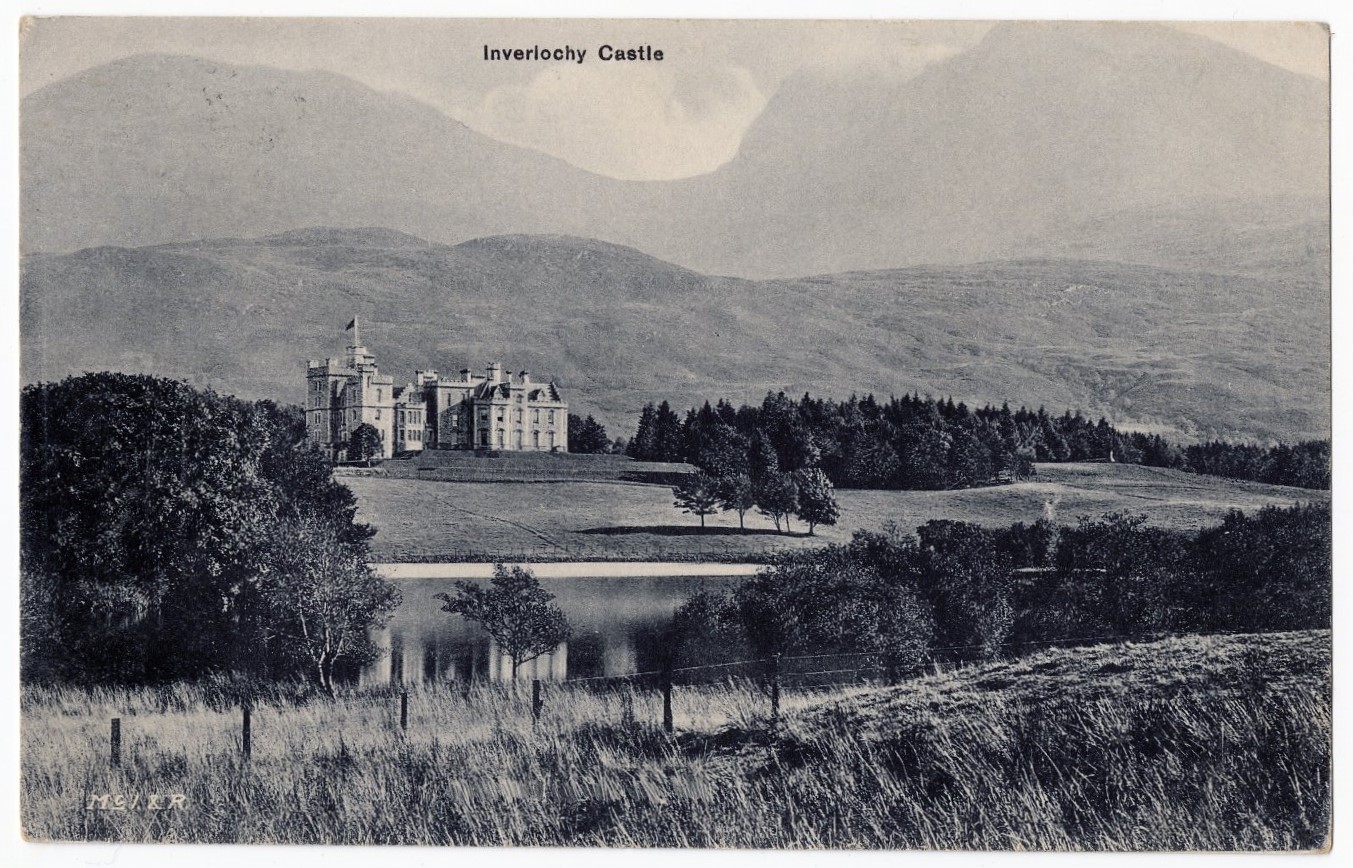
Evelina’s childhood home was quite literally fit for a queen, as proven when in September 1873 Queen Victoria with Princess Beatrice, Lady Churchill, Colonel Ponsonby and Dr Fox stayed at Inverlochy Castle during a tour of the Highlands. Painting and sketches made by Queen Victoria during her stay at Inverlochy are held in the Royal Collection Trust.
A report of Queen Victoria’s visit to Inverlochy was published in the Morning Post on 10 September 1873, which included the following description of Inverlochy Castle:
‘The estate, which extends to 64 square miles, is principally moorland… The house is built on a commanding site, and as the old Scotch style of architecture has been adopted, its towers and turrets and crow-stepped gables command the attention of the visitor while he is yet miles away. The main front of the building is to the south, and the principal entrance to the east. A beautiful portico leads to the main door, above which trophies of the chase, consisting of the skulls of three stags polished to a glittery white, with handsome antlers springing from each of these skulls, are exhibited. On a prominent part of the doorway may be seen the arms of Lord Abinger – the lion rampart, with the motto Suis stat viribus – ‘He stands by his strength.” The entrance hall is decorated with the heads of the Highland deer, and ornamented with paintings. A number of paintings by various masters are hung in the other rooms, and several busts, including one of Lord Abinger, are arranged in the different apartments. The castle contains 30 rooms – those reserved for the Queen being in the newer part of the building – her Majesty’s sitting room being over the drawing room. Little or no care has been expended on the surrounding grounds, and they are consequently almost as wild as the adjoining moor.’[16]
Evelina had a privileged childhood. The Scarlett children were looked after by an army of servants. The 1871 census, which was taken shortly after the birth of Evelina’s brother younger James, lists a household staff of thirteen with a monthly nurse, a wet nurse, a nurse maid, a head nurse, a head housemaid, an under housemaid, a lady’s maid, a scullery maid, a kitchen maid, a cook, two footmen, and a butler. According to the season, the family divided their time between Inverlochy Castle, Abinger Hall in Surrey, and no.46, Cornwall Gardens in South Kensington, but it was at Inverlochy where Evelina was happiest, spending her days outdoors with their ghillie Sandy Cameron.[17]
Like his father, Evelina’s brother James was educated at Eton, but under their mother’s influence Evelina and her sisters received a liberal education provided by governesses and at private schools, with time spent on the Continent where Evelina was able to develop her aptitude for languages.[18] Evelina’s elder sister Ella Campbell Scarlett (1864-1937) was clearly extremely intelligent and having studied music at the Kӧnigliche Conservatorium in Vienna she went on to study medicine, receiving degrees from both the London School of Medicine for Women and Brussels University. Ella became the first female doctor appointed in the state of Bloemfontein, South Africa, and later set up her own medical practices in South Kensington and Canada.[19]
On 10 February 1887, six months after her nineteenth birthday, Evelina was married at St Stephen’s church, South Kensington to 40-year-old Major Henry (‘Jack’) Wykeham Brook Tunstall Haverfield (1847-1895), an officer in the Royal Artillery and son of the late Major John Haverfield (1810-1885) and Zara Haverfield (née Ottley) (1807-1887) of Rosemount, Lyncombe, Somerset.
Evelina and Henry’s wedding was a society event and was reported in the fashionable press. The following account appeared in the Lady’s Pictorial:
‘The marriage of the Hon. Evelina Scarlett, youngest daughter of Lord and Lady Abinger, of Inverlochy Castle, Kingussie, N.B., and Major H.W.B.T. Haverfield, R.A., A.D.C., took place on Thursday afternoon last week, in St Stephen’s Church, South Kensington. Colonel Blackley, Royal Artillery, accompanied the bridegroom as best man. The bride, who was given away by her father, Lord Abinger, wore a dress of cream broché satin, embroidered with pearls, the long train being edged with the same, and a few sprays of orange blossoms in her hair, which was covered by a long tulle veil, fastened by diamond ornaments, the gifts of the bridegroom. She also wore the amethyst ornaments presented to her by Lord Abinger’s Inverlochy tenants. The service was fully choral, the officiating clergy being the Rev. Sidney L. Smith, M.A., rector of Brampton Ash, and canon of Hereford Cathedral, assisted by the Rev. J.H. Calley, rector of Blunsdon, St Andrews, Wilts., and the Rev. Sidney Scarlett Smith. The wedding party afterwards assembled at Lord and Lady Abinger’s residence, 46, Cornwall Gardens, and among the guests were Field-Marshal Lord and Lady Napier of Magdala and Hon. Miss Napier, General Lord Chelmsford, Lord and Lady Esher, Lady Isabella Keene, Lord Campbell, Lady Russell, Viscount and Viscountess Gort and Hon. Miss Vereker, Hon. Mrs Toler, Miss Toler, and Miss Violet Toler, Hon. F. Napier, Hon. J.Y.M. Scarlett, Hon. Hallyburton and Mrs Campbell, Canon and Hon. Mrs Sidney Smith and the Misses F. and L. Smith, Mr and Hon. Mrs Hardcastle, the Rev. W.A. and Hon. Mrs Duckworth, General Sir Daniel and Lady Lysons, the Right Hon. Hugh and Mrs Childers, Mrs and Mrs Vaughan Johnson and Miss Vaughan Johnson, Hon. Dudley Campbell, Sir George and Lady Stephen, Sir Gerald and Lady Dalton Fitzgerald, Sir Francis and Lady Grant of Monymusk, Sir Alexander and Lady Hood and Miss Hood, General Sir Edward Hodge, Lieutenant-General and Mrs Pakenham, General and Mrs Smythe, and Sir Dagald and Lady Stewart. Major and Mrs Haverfield left Cornwall Gardens for the Continent on their wedding tour.’[20]
At Inverlochy, the wedding was celebrated by the firing of a salute from the terraces at Inverlochy Castle and the lighting of bonfires, including one on top of Ben Nevis. The children at Tomacharich, where the previous summer Evelina had set up a Sunday School, also lit a special bonfire in honour of their former teacher’s marriage.[21]
After their honeymoon, Evelina and Henry settled in Exeter where Henry’s regiment was stationed. It was here that Evelina gave birth to their two children, John Campbell Haverfield (1887-1915) was born on 4 December 1887 at Southlands, Heavitree Road, Exeter, and Brook Tunstall Haverfield (1889-1954) was born on 30 March 1889 at Mount Wear, Topsham.
On 13 March 1890, possibly as a result of ill health, Henry retired from the army[22] and the family moved to West Hall, an Elizabethan manor house at Folke near Sherborne, Dorset. Their choice of a home in the heart of the Blackmore Vale was probably because of Evelina’s love of riding and hunting. The area was renowned fox hunting country and from West Hall Evelina had easy access to the Blackmore Vale Hunt, the Portman Hunt, and the Cattistock and South Dorset Hunt.

The 1891 census for West Hall lists a household staff of six live-in servants – a nurse, butler, housemaid, kitchen maid, coachman, and cook. It was perhaps for the benefit of her cook 25-year old Alice Lewis that Evelina began compiling a book of recipes.[23] The book contains a variety of recipes for sweet and savoury dishes that reflect Evelina’s Scottish and American heritage and time spent on the Continent. It includes a recipe for the French classic Bonne Femme Soup (literally meaning ‘good wife’ or ‘good woman’) given to her by Arthur R. Merer (the chef de cuisine at St. James’s Club in Piccadilly), Warfield Pudding, Potato Pudding (made with mashed potato), Mysterious Pudding (made with marmalade), Gaufres à la crème (waffles with cream), Brandy Peaches, Scotch Haggis, Cold Fig Pudding, Indian Batter Cakes, American Corn Cakes (made with Indian meal from Jacksons of Piccadilly), Corn Slappers (made with Indian meal mixed with wheat flour), pilaf, brioches, Sally Buns, Rabbit Cream, Barley Water (from ‘Arthurs’ Club), Sheep’s Head Pie, Ginger Beer, Lemonade, Toasted Cheese, and Chocolate Pudding. The book also includes medicinal recipes for both humans and horses, including cough mixture (raisins, sugar candy & liquorice), hoof ointment (tallow or mutton fat & Stockholm tar), hair wash (hops & rum), treatments for thrush (sulphate zinc & water) and for brittle feet (tar, tallow, beeswax).
Evelina’s husband Henry meanwhile was becoming progressively unwell and by summer 1891 he was exhibiting symptoms known as general paralysis of the insane (GPI), a severe degenerative disorder caused by late-stage syphilis. With two young children at home this must have put a terrible strain on Evelina. On 16 January 1892 Evelina received another blow when her father died at Fort William after only a week’s illness.[24] A year later Henry’s health had deteriorated to such an extent that on 1 January 1893 ‘Maj. Haverfield being a lunatic’ was written beside his name in the Army retirement pay accounts.[25] It is probable that Evelina’s interest in nursing, which eventually led to her joining Dr Elsie Inglis’s Scottish Women’s Hospitals in 1915, was a direct result of her experience nursing her husband during his devastating illness.

In 1893, whether because Evelina was looking for a bigger house, better stabling for her horses or a more secluded location for Henry, the family left West Hall and moved to nearby Marsh Court at Caundle Marsh.[26] It was here that Henry died on 20 January 1895, aged 48, just a few weeks short of their eighth wedding anniversary, leaving Evelina a widow at the age of 27. The death certificate records his cause of death as ‘General Paralysis, 3 years & 6 months, convulsions, coma.’
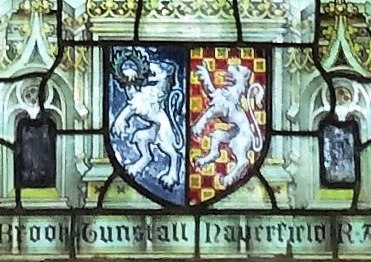
Henry was buried on 24 January 1895 in the churchyard of Bishop’s Caundle church. The funeral was conducted by the Rev. Canon Edward Wyndham Goodden (1847-1924) who in April 1909 attended the inaugural meeting of the Sherborne branch of the NUWSS. Evelina had a memorial window for Henry installed at the church depicting Jesus praying in the garden of Gethsemane. The window includes a combined Haverfield/Abinger crest and the initials ‘HH’ and ‘EH’, with the following inscription – ‘In loving memory of Major Henry Brook Tunstall Haverfield R.A. born 1846 died 1895. Erected by his wife.’

Four years after Henry’s death, on 8 July 1899, Evelina, now aged 31, was married at Caundle Marsh church to one of Henry’s army friends, 40-year-old widower Major John Henry Balguy (1859-1933) of the Royal Artillery.[27] Recording the event in her diary Evelina wrote: ‘I married Major Balguy R.A. with no intention of changing my name or mode of life in any way. He is an old friend of my darling Jack’s. The ceremony took place at Caundle Marsh Church in the presence of Mrs. C., my “parlour boarder”, and Shepherd, my groom.’ The witnesses were in fact Mary Corbin Cutter[28] and William Henry Shepherd. A few months later, on 18 September 1899, Mary Corbin Cutter was married at Caundle Marsh church to Major Balguy’s brother Charles Bertram Ogle Balguy (1861-1941). Both Major Balguy and Evelina were witnesses at the wedding.

Was Evelina’s marriage to Major Balguy merely a marriage of convenience or a love match? It is hard to tell. Although they remained married until Evelina’s death in 1920, from the outset their marriage was unusual. On 29 July 1899, twenty-one days after their wedding, Evelina signed a deed poll stating she would be resumin the surname of her first husband. [29] [30] The deed poll was witnessed by General Sir Julius Richard Glyn KCB (1824-1905) of Sherborne House[31].

Evelina and Major Balguy had much in common. Not only had he known her first husband with whom he had served in the Royal Artillery, but he had twin daughters, Dorothy Avis Balguy (1886-1952) and Violet Irene Balguy (1886-1985), who were a similar age as Evelina’s own children and, perhaps more importantly, they shared an interest in horses, riding and hunting. Major Balguy had a distinguished military career, having joined the Royal Artillery from the Royal Military Academy Woolwich in 1879 he retired in 1910 with the rank of Lieutenant-Colonel on the completion of his service in command of the Royal Garrison Artillery (RGA) Weymouth. Major Balguy served in the 1899-1902 South African Campaign (Anglo-Boer War), where in 1901 Evelina joined him and worked as his assistant, and where in May 1902 she set up a remount camp for the thousands of horses abandoned at the end of the conflict.
In October 1905 it was announced in the Western Chronicle that Major Balguy and Mrs Haverfield had returned to Marsh Court after their long absence abroad.[32] Evelina again became actively involved with the local community, serving as overseer of the parish of Caundle Marsh and as a co-opted member of the local Old Age Pensions Committee. In 1907 she gave £4.10s to buy a wheelchair with a leg extension for a paralysed young man who was a patient at the Yeatman Hospital in Sherborne. Ernest Dark (1889-1908) had been knocked down by a car at South Cadbury while leading a horse along the road and, despite not having been expected to survive his injuries, he lived for over 3 years, dying at the Yeatman Hospital on 7 December 1908, aged 19.[33]
By 1907/8 Evelina had begun to take an active interest in the Women’s Suffrage Movement.[34] She was initially supported in this by Major Balguy who on 23 April 1909 attended the inaugural meeting of the Sherborne branch of the NUWSS. However, by 1910 they had separated and when Major Balguy retired that year from the army he moved to Bockhampton near Dorchester and Evelina gave up Marsh Court and moved to a cottage at Brendon near Lynton in North Devon which she renamed Peace Cottage. This area of Devon was already well known to Evelina because of time spent hunting with the Devon and Somerset Stag Hounds and visits to her close friend Ethel Acland Hood (1857-1943) who lived at Brendon House.[35]
In 1909 Evelina began a close friendship with Vera Holme (1881-1969), a fellow suffragette with whom she shared a love of horses and riding. On 5 October 1909, when they were both in Edinburgh preparing to take part in a women’s suffrage parade, Vera wrote a ‘Poem for Eve’ in memory of ‘the morn we rode together round the hill Arthurs Sea Edinboro’ when we were both so happy drinking in the full joys of nature which can seem more beautiful than ever when your twin soul is at your side.’ Written in the form of an acrostic poem, the first letter of each line spelt out Evelina’s name:
‘Early the morn, list! The songbird sings sweet
Varied the pleasures I meet on my ride
Every gift nature has falls at my feet
Horse – thou my good friend, through all time and tide
Away thou and I, from life’s maddening throng
Valliant old fellow, just gallop along –
Eager to do my desire? Ay I know
Resolute boys, yes – I know you can go!
Field it is ours – you are leading the way
Incline or hill – n’er to slow you they tend
Even the fields left behind us look grey
Leader’, well named, you have carried your friend
Dear.’ [36]
Evelina and Vera’s relationship would last until Evelina’s death in 1920. They shared Peace Cottage at Brendon where the sides of their bed was carved with their initials – ‘E.H.’ and ‘V.H.’[37]
As a result of her militant activities in the WSPU Evelina acquired a certain degree of celebrity. On 28 July 1911 an advertisement appeared in Votes for Women in which Evelina endorsed the Samuel Brothers’ ‘Omne Tempus’ raincoat – ‘A well-known Suffragist Leader, the Hon. Mrs. Haverfield, writes as follows about her ‘Omne Tempus’ Raincoat – “I shall have much pleasure in recommending your raincoats. They are not only perfectly rainproof, but the cut and make, being perfectly smart, enable them to be worn in all kinds of weather.” The advertisement went on to recommend the ‘Omne Tempus’ as ‘The Ideal Coat for Town Country, or Campaigning’, with the promise that “If your ‘Omne Tempus’ fails to keep out the rain, we will take it back.”

With the outbreak of the First World War in July 1914, the women’s suffrage societies encouraged their members to abandon their campaigns and to use their efforts to support the war effort. At Sherborne in August 1914 the NUWSS presented Sherborne ‘G’ company of the 4th Dorsets with 120 pairs of socks[38] and many of its members went on to work work during the war for the Voluntary Aid Detachments (VAD).[39]
The war years brought personal tragedy for Evelina. On 13 February 1915 her mother Helen Lady Abinger died at no.46, Cromwell Gardens, South Kensington. Evelina was the chief mourner at the funeral which took place at St Andrew’s Episcopal Church in Fort William prior to burial in the family crypt at Inverlochy Castle. Just five months later Evelina eldest son Lieutenant John Campbell Haverfield (1887-1915) was wounded while serving with the 24th Punjabis in Mesopotamia and died from his injuries at Basra on 14 July 1915, where he was buried in Basra War Cemetery.[40]
Evelina was keen to enable women to contribute actively to the war effort. Unable initially to leave England because of her mother’s ill health, she played a pivotal role in the formation of the Women’s Emergency Corps and the Women’s Volunteer Reserve (WVR). After her mother had died, in May 1915 Evelina joined Dr Elsie Inglis’s Scottish Women’s Hospitals (SWH) with whom she travelled to Serbia to help with relief work, but also made frequent visits back to England to raise funds for the Serbian Red Cross and the Fund for Disabled Serbian Soldiers. [41] For their work the Serbian Government presented Dr Inglis with the decoration of the White Eagle and Evelina with the Order of St Sava, saying ‘The Serbian Nation will never forget what the Scottish women have done for them.’
Evelina was back fundraising in England on 6 February 1918 when the Representation of the People Act 1918 was passed, granting the vote to women over the age of 30 who met a property qualification. It was the British Government’s recognition of women’s war service rather than their political lobbying and militant actions that eventually resulted in women being given the vote. The first general election in England in which women were allowed to vote was held on Saturday 14 December 1918. At polling day in Sherborne, women made the most of their first opportunity to cast their vote and it was noted that ‘More women voted than had been anticipated, and in some cases outnumbered the men.’[42] The votes were counted in the Big Schoolroom at Sherborne School and the result declared from the roof of the adjoining cloisters[43] with Major W.P. Colfox winning 50.7% of the vote.[44]
On 8 February 1918 Evelina made what was probably her last visit to Sherborne when, as part of her fundraising tour to raise money for the Serbian Red Cross and the Fund for Disabled Serbian Soldiers, she gave a lecture at Sherborne School. After the lecture one attendee wrote in his diary – ‘Heard Mrs Haverfield lecture on Serbia in Schoolroom. We in England know nothing of suffering compared with this heroic nation wh. has been deliberately murdered.’[45]
Evelina’s close connection with Serbia did not end with the signing of the Armistice on 11 November 1918. In December 1918 she returned to Serbia to help with relief work and, following a request from the Serbian government, she focused her efforts on the plight of the many orphans left by the war, setting up orphanages at Užice and Bajina Bašta. During the winter of 1919 she wrote to her son Brook, who was then living in British Columbia with his wife, saying she hoped to visit them the following summer.[46] Sadly, she never made the trip because in March 1920 she was taken ill and on 21 March 1920 she died from pneumonia, aged 52. Her last words are said to have been ‘What will become of the children?’[47] She was buried at Bajina Bašta where her headstone is inscribed with the words ‘A good rider. A good fighter. A most loyal friend.’

The Rev. Claude Hinscliff (1875–1964), who had assisted in 1913 at the funeral of suffragette Emily Wilding Davison (1872-1913), was British Chaplain in Belgrade in 1920 and on hearing of Evelina’s death made the long journey from Belgrade to Bajina Bašta to conduct her funeral. His description of the journey to Bajina Bašta and of Evelina’s funeral was published in the Church League for Women’s Suffrage:
‘I left Belgrade at 2.30 on the Sunday and got to Bajina Bašta on the Tuesday evening. It was automobile until the last 36 kilometers, where a carriage was necessary to cross three mountain ranges. What with rain and snow, landslides and engine trouble, and just a few hours at night of rest in village inns, we were pretty tired out. The last lap was a little exciting because it was ‘Commitadgé’ country, and there was a possibility of being held up at any moment. The body was put in the Church, where it rested before the Ikon and the Golden Doors. I closed the coffin and put on it the Union Jack, and the Jugo-Slave flag with her cap and belt on top. The Wednesday morning, a glorious spring morning, saw the service and interment.’[48]
Two months after Evelina’s death a memorial service was held on 1 May 1920 at Southwark Cathedral in London. The following report of the memorial service was published in the Western Gazette:
‘The Serbian national flag was hoisted on Saturday on the tower of Southwark Cathedral, where a memorial service was held in the afternoon for the Hon. Mrs Haverfield, daughter of the third Lord Abinger, who died of pneumonia in Serbia, after long devoted work on behalf of its suffering people. Princess Marie Louise was represented by Miss Hawkes, and the Serbian Minister and many of the personnel of the Legation were present. The congregation also included: Mrs Chapman (cousin), Countess Cathcart, the Dowager Countess of St Germans, Sir Edward Boyle (accompanied by Lady Boyle and Constance Lady Boyle), with Mrs Carrington-Wilde, Lady Grogan, and Mrs Seton-Watson, representing the Serbian Relief Fund; Mr Frank Hastings, representing the Serbian Red Cross; Mrs Beatty, representing the Green Cross, of which Mrs Haverfield was president; Miss Helen Ward and other representatives of the Scottish Women’s Hospitals; Miss A.M. Onslow (chairman), the Hon. Mrs St John Mildmay, Miss Lawrence, Miss W.E. Hall, Miss Christabel Ellis, Mrs Baxter, and Miss C. Nina Boyle, representing the Hon. Mrs Haverfield’s Fund for Serbian Children; Mrs Robert Frank, Mrs Henry Fawcett, Miss Simonis, and a great many others, including members of the Green Cross and of the Women’s Patrol, in uniform. The service was conducted by Canon Haldane (the Precentor), the Succentor (the Rev. T.P. Stevens), and the Rev. A. Anders, and the full Cathedral choir was in attendance. On the rail in front of the sacrarium was hung the embroidered flag which Mrs Haverfield hoisted over her headquarters when touring this country raising funds for her work in Serbia. The music of the service included “Kossovo,” a song commemorating the glory of Serbia, composed by Miss Ethel Zillhart (who was present in the Cathedral), and dedicated to Mrs Haverfield. The choir also rendered the Russian “Contakion of the Departed,” “Justorum Animae” (Byrd), “In Manus tuas” (Tallis), two motets from Sir Hubert Parry’s “Songs of Farewell,” namely, “My soul, there is a country,” and “There is no old belief,” and the last chorus from Brahams’s Requiem, “Blessed are the dead.” At the end of the service Chopin’s “Marche Funebre” was played. In an address Canon Haldane said Mrs Haverfield was a woman of singularly powerful personality and great charm, with a wonderful capacity for organisation and the most indomitable courage. She had done relief work of the utmost value from the earliest stages of the war in Serbia, and at the time of her death was labouring hard for the orphans, of whom there were hundreds of thousands in that country.’[49]
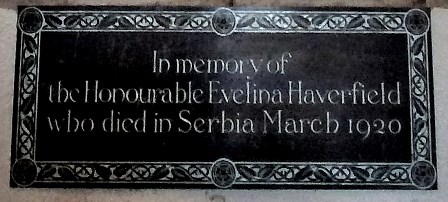
In 1923 a memorial tablet was installed at Bishop’s Caundle church beneath the Haverfield memorial window Evelina erected for her first husband. It reads:
‘In memory of the Honourable Evelina Haverfield who died in Serbia March 1920.’
Rachel Hassall
31 December 2025
Further reading:
Elizabeth Crawford, The Women’s Suffrage Movement. A Reference Guide 1866-1928 (London: Routledge, 2001)
Elizabeth Crawford, The Women’s Suffrage Movement in Britain and Ireland. A Regional Survey (Abingdon: Routledge, 2006)
Boyce Gaddes, Evelina. Outward Bound from Inverlochy (Gloucester: Merlin Books Ltd., 1995)
Wendy Moore, Jack and Eve. Two Women in Love and at War (London: Atlantic Books, 2024)
Pamela Vass, Breaking the Mould. The Suffragette Story in North Devon (Bideford: Boundstone Books, 2017)
See also:
Papers of Vera (Jack) Holme, Women’s Library, LSE
Evelina Haverfield’s recipe book
Sherborne & the fight for women’s suffrage
Footnotes:
[1] Elizabeth Crawford, The Women’s Suffrage Movement. A Reference Guide 1866-1928, p.215.
[2] Western Gazette, 12 March 1909.
[3] Western Chronicle, 30 April 1909.
[4] Western Chronicle, 30 April 1909.
[5] Western Chronicle, 30 April 1909.
[6] Boyce Gaddes, Evelina. Outward Bound from Inverlochy, p.45. The letter from Evelina to her sister was published in a newspaper in Edmonton on 3 September 1909.
[7] Boyce Gaddes, Evelina. Outward Bound from Inverlochy, p.50.
[8] Elizabeth Crawford, Art and Suffrage. A Biographical Dictionary of Suffrage Artists (2019), pp.143-149.
[9] Boyce Gaddes, Evelina. Outward Bound from Inverlochy, p.58.
[10] Western Gazette, 2 July 1909.
[11] A short biography of The Honorable Evelina Haverfield’ by Vera L. Holme, c.1920. Papers of Vera (Jack) Holme, Women’s Library, LSE ref. 7VJH/4/1/03
[12] Astrological chart for Evelina Haverfield. Papers of Vera (Jack) Holme, Women’s Library, LSE ref. 7VJH/4/2/17
[13] ‘A short biography of The Honorable Evelina Haverfield’ by Vera L. Holme, c.1920. Papers of Vera (Jack) Holme, Women’s Library, LSE ref. 7VJH/4/1/03
[14] ‘American Peeress Has Keen Revenge, The San Francisco Call, 12 August 1906, p.28.
[15] ‘The Late Lady Abinger’, The Scotsman, 16 February 1915.
[16] ‘The Queen’s visit to Inverlochy Castle’, Morning Post, 10 September 1873.
[17] ‘A short biography of The Honorable Evelina Haverfield’ by Vera L. Holme, c.1920. Papers of Vera (Jack) Holme, Women’s Library, LSE ref. 7VJH/4/1/03. Vera writes
‘From her earliest days she showed a distinct liking for sport in preference to social functions, and nothing pleased her more than to put on an old Ulster and go off for the day with her faithful Ghilli Sandy Cameron, who she never forgot, as she always used to send him a cheque and a piece of beef for his Christmas dinner until he died.’
[18] Boyce Gaddes, Evelina. Outward Bound from Inverlochy. A Biography of the Hon. Evelina Haverfield (Merlin Books, 1995), p.9.
[19] ‘Ella Campbell Scarlett’, Wikipedia (accessed 15 July 2025).
[20] Lady’s Pictorial, 19 February 1887.
[21] ‘Rejoicing on the Inverlochy Estate’, Oban Times and Argyllshire Advertiser, 19 February 1887.
[22] Royal Hospital Chelsea: Register of Payments: E-K, TNA ref. WO 23. Entry for Henry Wykeham Brook Tunstall Haverfield, born 23 May 1846, Major, Royal Artillery. G. 18/3/90. Paid Retirement pay from 19 March 1890. With a note ‘to be paid by F6 from 1-1-93 (Maj. Haverfield being a lunatic).’
[23] Recipe book belonging to Evelina Haverfield, 1893. Papers of Vera (Jack) Holme, Women’s Library, LSE ref. 7VJH/4/1/06
[24] James Yorke Macgregor Scarlett, 4th Baron Abinger, was born on 13 March 1871. He was educated at Eton & Trinity College, Cambridge. He served with the Queen’s Own Cameron Highlanders in the Second Boer War. He died on hearth failure on 11 December 1903 caused by an accidental fall down a flight of stairs at a Paris restaurant. The title of Baron Abinger then went to his second cousin, Shelley Scarlett (1872-1917).
[25] Royal Hospital Chelsea: Register of Payments: E-K, TNA ref. WO 23. Entry for Henry Wykeham Brook Tunstall Haverfield, born 23 May 1846, Major, Royal Artillery. G. 18/3/90. Paid Retirement pay from 19 March 1890. With a note ‘to be paid by F6 from 1-1-93 (Maj. Haverfield being a lunatic).’
[26] The following advertisement appeared in the Western Gazette on 27 January 1893: ‘MARSH COURT, CAUNDLE MARSH, TO BE LET. This House is situated four miles from Sherborne, and contains drawing-room, dining-room, seven bedrooms, dressing-room, housekeeper’s-room, kitchens, &c. Good stabling for six horses, coach-houses, two kitchen gardens, Cottage if desired. Rent moderate. Apply to Messrs BARTLETT & SONS, solicitors, Sherborne; or to Mr THOMAS FARRALL, House Agent, Sherborne.’
[27] John Henry Balguy (1859-1933) was educated at Eton and the Royal Military Academy Woolwich and in 1879 joined the Royal Artillery. He married his first wife Mary Nicholson (1864-1898) in 1885 and they had twin daughters, Dorothy Avis Balguy (1886-1952), who was married in 1916 to Philip Reginald de Belward Egerton (1885-1962), and Violet Irene Balguy (1886-1985) who was married in 1911 to Edward Litton Luther (1866-1951). Mary died on 9 July 1898 in Uttar Pradesh, India. In 1899 he married Evelina Haverfield (1867-1920). He served in the South African Campaign (Anglo-Boer War). He retired in 1910 on the completion of his service in command of the RGA at Weymouth with the rank of Lieutenant-Colonel. At the outbreak of the First World War, he returned to the Colours and commanded a division from October 1914 to March 1916. In 1917 he was appointed Hon. Brigadier-General. From 1911 to 1924 he was County Director in Dorset of the British Red Cross and took an interest in the work of the Children’s Red Cross War Memorial at Swanage. He was secretary of the annual tennis tournament held at Kingston Park, Dorchester. Brigadier-General Balguy died on 27 December 1933 at his home at Bockhampton near Dorchester, Dorset, and was buried in Stinsford churchyard on 30 December 1933.
[28] Mary Edwine/Edwina Corbin (1872-1941) appears to have been a friend of Evelina Haverfield, who described her in her diary on 8 July 1899, when she witnessed her wedding to Major John Henry Balguy (1859-1933), as her ‘parlour boarder’. Mary was born on 28 August 1872 at Helena, Montana, USA, daughter of Daniel Chase Corbin and Helena (née Lewis). She was married on 6 October 1892 at Spokane, Washington, USA to Kirtland Kesley Cutter (1860-1939), an architect. They divorced in 1896. On 18 September 1899 she was married at Caundle Marsh church to Charles Bertram Ogle Balguy (1861-1941), brother of Major John Henry Balguy. Both Major Balguy and Evelina Haverfield were witnesses at their wedding. Mary and Charles were divorced in 1915. In May 1922, Mary was on the staff of the American Consulate General at Yokohama, Japan. She died on 27 April 1941 at Los Angeles, California, USA.
[29] The text of the Deed Poll reads as follows: ‘I The Honourable Evelina Balguy formerly Evelina Haverfield of Marsh Court Sherborne Widow but now the wife of John Henry Balguy of Landguard Lodge Felixstowe [‘Marsh Court Sherborne in the County of Dorset’ crossed out] a Major in the Royal Artillery do by these presents under my hand and seal intended to be forthwith enrolled in the Central Office of the Supreme Court of Judicature declare that I have assumed and intend henceforth upon all occasions and at all times to sign and use and be called and known by the surname of Haverfield in lieu of and substitution for my present surname of Balguy. As witness my hand and seal this twenty ninth day of July One thousand eight hundred and ninety nine. Signed Sealed and Delivered by the above named Evelina Haverfield in the presence of Julius Glyn Sherborne Dorset General Officer Retired. Enrolled in the Central Office of the Supreme Court of Judicature the third day of August in the year of our Lord 1899.’
[30] The text of the Deed Poll was also published as a notice in the Morning Post, 3 August 1899.
[31] General Sir Julius Richard Glyn KCB (1824-1905) was Colonel Commandant of the 2nd Battalion Rifle Brigade and served with the Rifle Brigade in South Africa during the Boer War, in the Crimea at the siege of Sebastopol and the battle of Alma, and in India at the capture of Lucknow. In 1890 he married Julie Ashe Showers (1841-1910), the widow of Colonel Hamilton Maxwell (1826-1889), and the following year they became tenants of Sherborne House in Newland, Sherborne, Dorset. General Sir Julius Richard Glyn died in London on 16 June 1905 and was buried on 20 June 1905 in Sherborne Cemetery. His widow, Dame Julia Glyn died at Sherborne House on 12 August 1910 and was buried beside her husband in Sherborne Cemetery on 15 August 1910.
[32] ‘Return of Major Balguy’, Western Chronicle, 6 October 1905.
[33] Ernest Dark (1889-1908), Findagrave (accessed 31 December 2025)
[34] ‘A short biography of The Honorable Evelina Haverfield’ by Vera L. Holme, c.1920. Papers of Vera (Jack) Holme, Women’s Library, LSE ref. 7VJH/4/1/03
[35] Ethel Fuller Acland Hood (1857-1943), daughter of Sir Alexander Fuller Acland Hood, 3rd Baronet (1819-1892), MP for West Somerset, and Isabel Harriet, Lady Acland (1832-1903), of St Audries, West Quantoxhead, Somerset. In 1891, when the census was taken, Ethel Acland Hood was visiting Evelina Haverfield and her family at West Hall, Folke, and on 2 April 1911, when the 1911 census was taken, Evelina’s stepdaughter Dorothy Avis Balguy (1886-1952) was staying with Ethel Acland Hood at Brendon House, Lynton, Devon. She died at Brendon House on 16 August 1943. Her obituary in the North Devon Journal (19 August 1943) stated she had taken a great interest in the local Nursing Association, in aid of which her annual jumble sale became a well-known institution. She was also an active member of the Church.
[36] Manuscript poem to Evelina Haverfield by Vera Holme, 5 October 1909, Women’s Library, LSE ref. 7VJH/4/1/08
[37] An inventory of Vera Holme’s property at Peace Cottage, c.1920, Women’s Library, LSE ref. 7VJH/4/1/07
[38] Western Gazette, 4 September 1914.
[39] Rachel Hassall, Sherborne School and the Greenhill VA Hospital (accessed 30 December 2025)
[40] Lieutenant John Campbell Haverfield (1887-1915), Findagrave (accessed 31 December 2025)
[41] Elizabeth Crawford, The Women’s Suffrage Movement. A Reference Guide 1866-1928, pp. 279-280.
[42] Western Gazette, 20 December 1918.
[43] Western Gazette, 20 December 1918.
[44] North Dorset (UK Parliament constituency), Wikipedia (accessed 11 March 2020).
[45] Sherborne School Archives, extract from the diary of Henry Robinson King (1855-1935) for 8 February 1918.
[46] Boyce Gaddes, Evelina. Outward Bound from Inverlochy (1995), p.119.
[47] Account of the work of Evelina Haverfield in Serbia, c.1920. Papers of Vera (Jack) Holme, Women’s Library, LSE ref. 7VJH/3/2/04
[48] Church League for Women’s Suffrage, 1 June 1920.
[49] Western Gazette, 7 May 1920.