Women have always been inventive. Where would we be today without Ada Lovelace (1815-1852)[1] who wrote the first computer programme, or Marie Cure (1867-1939)[2] the first woman to receive the Nobel Prize who discovered radium and polonium and used her knowledge to improve x-ray machines, or Dorset-born business woman Eleanor Coade (1733-1821) [3] who developed Coade stone, the artificial stone that features on such iconic buildings as St George’s Chapel, the Royal Pavilion at Brighton, and Buckingham Palace?
Although the establishment of the UK Patent Office in 1852[4] enabled women to protect their copyright in an idea, it was not until 1882 and the passing of the Married Woman’s Property Act that a married woman could receive payment independently of her husband if her designs were produced.
A search of the European Patent Office (EPO) database[5] reveals two patents have been granted to Sherborne women. The first was granted in 1895 to Gussie Louisa Wilson of The Green for a hot water doll (Patent no.14,984)[6], and the second in 1897 to Mary Alice Campbell of Corn Hill House for a new or improved device for crimping, curling or waving hair (Patent no.519) .[7]
Gussie Wilson, Sherborne’s first ‘mistress of invention’, was born Augusta Louisa Jarvis on 19 July 1855 at Guelph, Ontario, Canada, daughter of William Dummer Powell Jarvis (1821-1860) and Diana Irving (1825-1900). On 12 August 1880 Gussie was married at the Ascension Church in Hamilton, Ontario, to Thomas Ward Wilson (1849-1924), an assistant master at Sherborne School. After their marriage Gussie and Thomas returned to England and set up home at Sherborne where they lived until Thomas’s retirement in 1908.
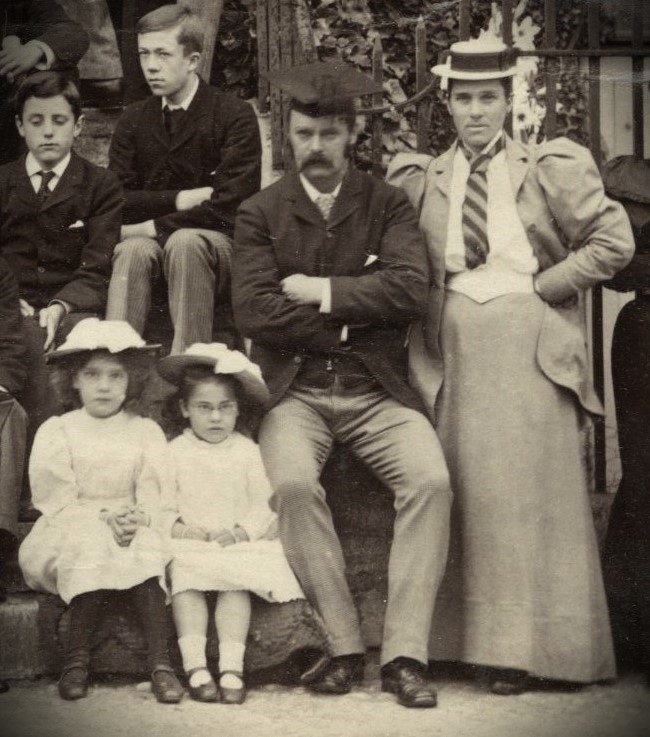
On 4 August 1894, Gussie submitted to the Patent Office her patent application for a hot water doll. The Provisional Specification describes Gussie’s concept: ‘My invention relates to a construction of a hot water vessel in the form of a doll to be nursed by a chid or laid beside the child so as to give warmth and comfort as well as to amuse.’
A more detailed complete specification, with a drawing of a rear view of the hot water doll, was submitted on 3 May 1895, in which Gussie described the construction of the doll:
‘In carrying the invention into practice, I construct the body (a) of the doll, of India rubber or other suitable flexible waterproof material, of any desirable form, and provide same with a short flexible or other tube (b) the mouth of which is closed by a screw or other plug (b1), such tube (b) as shewn a simple inlet and outlet orifice, normally closed in any suitable manner, may be provided. The head (c) of the doll, may be formed integral with the body (a), or be fashioned of plaster and wax or the like and be suitably affixed to such body as in the form shewn in the drawing. A suitable covering (d) is provided for the body (a) of the doll, to which covering the limbs (e) may be conveniently secured. A pocket or sheath (d1) is provided upon the covering (d), for the purpose of normally covering and concealing the inlet and outlet tube.’ Gussie concludes her application, saying ‘having now particularly described and ascertained the nature of my said invention and in what manner the same is to be performed, I declare that what I claim is – A doll having the body thereof constructed in the form of a flexible vessel to contain hot water, and provided with an orifice suitably closed for filling and emptying such vessel.’
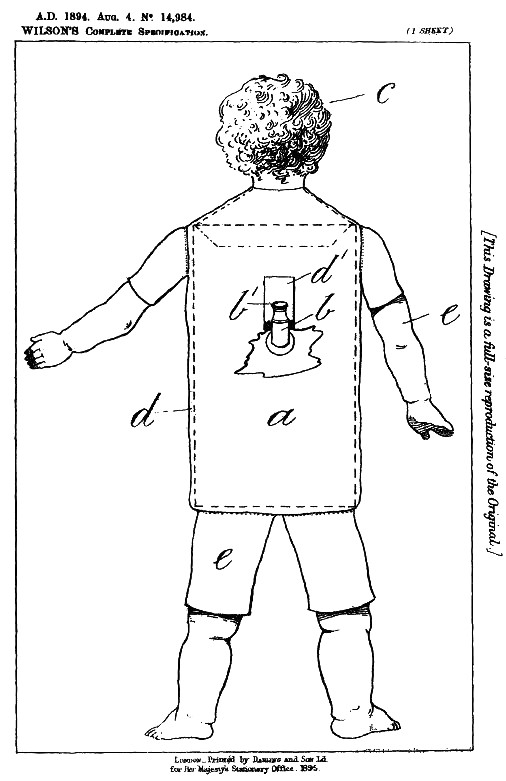
Gussie’s invention of a hot water doll was accepted by the Patent Office on 6 July 1895. Sadly, I have not been able to find out whether her design was commercially produced.
Gussie was obviously a woman with formidable energy. By 4 August 1894, when her patent application was submitted, she was 39-years-old and had been married to Thomas for 14 years. She had given birth to six children, three of whom (Hamilton, Charles, Aileen) had died when they were very young. In 1894 her surviving children were aged 11 (Thomas), 8 (Diana), & 4 ½ (Patience).
In 1880 Thomas and Gussie had opened a boarding house at The Green (formerly the Angel Inn) for boys attending Sherborne School. It was here that Gussie gave birth to her six children. Her first born, Thomas Irving Ward Wilson (1883-1916), was born at The Green on 5 January 1883. He lived until the age of 33 when he was killed in action during the First World War. Her second child, Hamilton Bernard Ward Wilson (1884-1886) was born at The Green on 31 August 1884 and died two years later on 7 October 1886 from tubercular meningitis. Her third child, Diana Ruth Wilson (1886-1969) was born at The Green on 31 May 1886 and went on to become a recognised botanical illustrator. Her fourth child, Charles Wilson was stillborn at The Green on 17 February 1888. Her fifth child, Aileen Augusta Wilson was born at The Green on 14 May 1891 but died eight days later from neonatal tetanus, an infection of the unhealed umbilical stump often caused by cutting the umbilical cord with a non-sterile instrument. Her last child, Patience Marguerite Wilson (1889-1944) was born at The Green on 9 December 1889 and went on to study at the Royal College of Music.
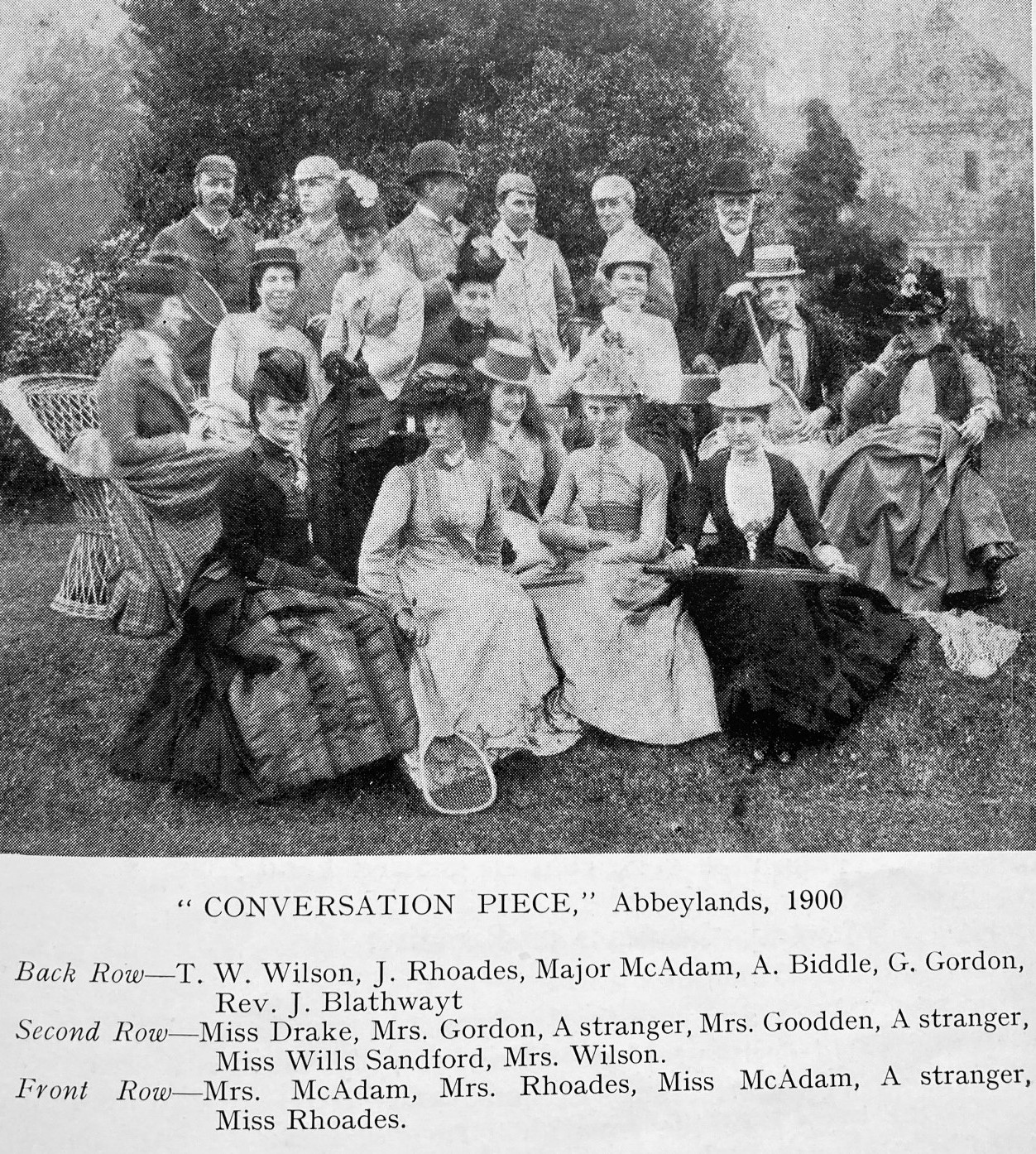
As the wife of a housemaster, Gussie had not only to look after her own family but was also responsible for the day-to-day running of the boarding house, which was effectively a small hotel. She had to ensure that the 25 boys who boarded with them were provided with three meals a day and a laundry service, and also manage the house staff, which in 1891 included six live-in members of staff – a matron, cook, nurse, parlour maid, housemaid, and a kitchen maid.[8]
It seems highly like that Gussie’s experience of looking after her own children and the schoolboys in her care inspired her invention of the hot water doll.
Gussie’s care for others is also revealed by gifts she made over the years to the town’s Yeatman Hospital,[9] which include: February 1904 – two garments and a basket of Canadian apples; November 1904 – old linen, books, magazines, toys, games, decorations for Christmas tree; December 1904 – jelly and trifle, oranges, apples, holly, flannel coat; May 1907 – children’s books and toys; June 1907- old linen; December 1907 – Christmas cake.
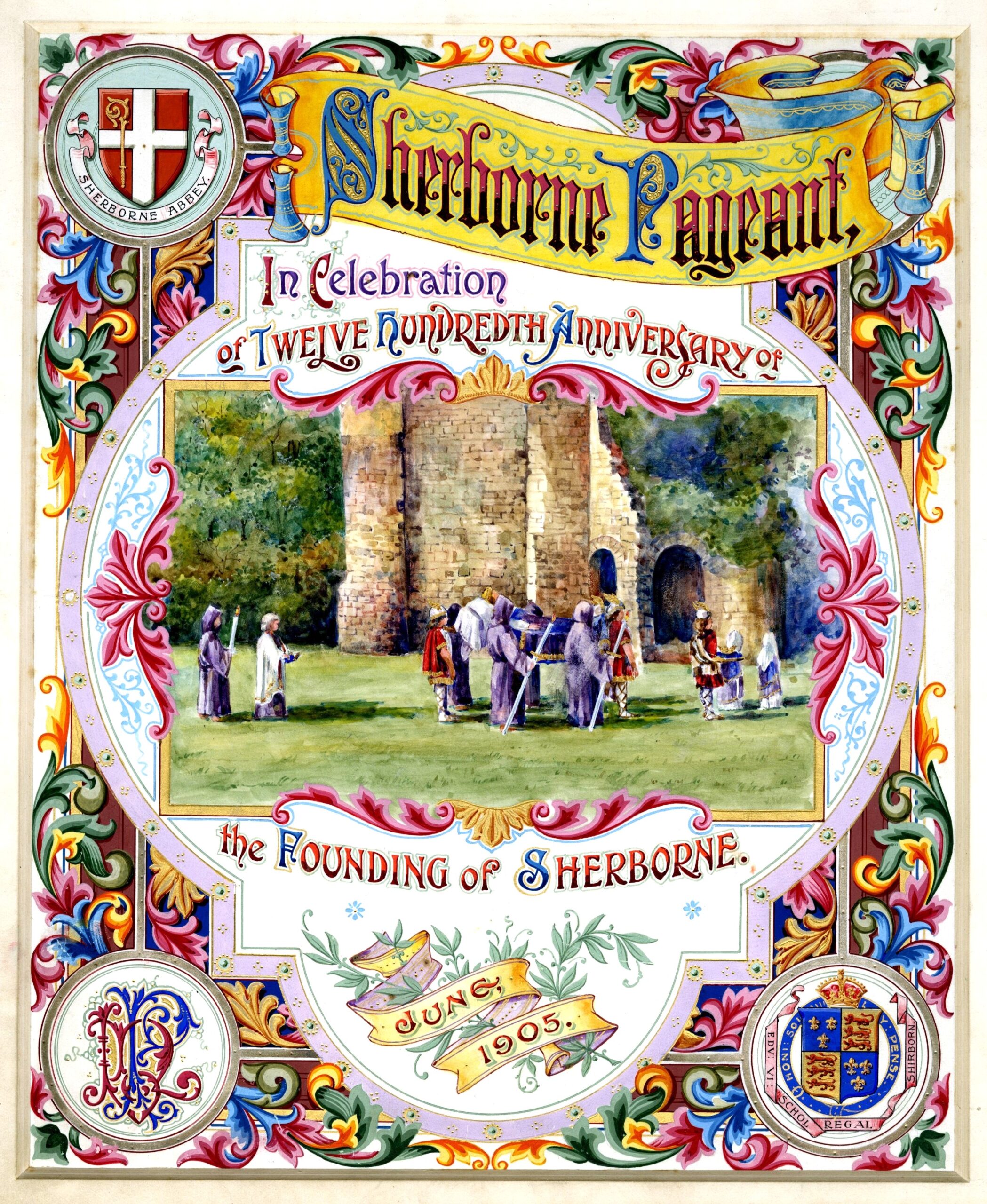
She was also involved in the social life of the town, taking part in 1905 in the Sherborne Pageant in which she played a Lady of Court, with her husband Thomas playing a tribesman, her daughter Diana playing a Queen, and her youngest daughter Patience singing soprano in the Dramatic Chorus. That year Gussie and Thomas gave up The Green boarding house and moved to Nortons in The Avenue.
Following Thomas’s retirement from teaching in 1908 they left Sherborne, moving to Uploders House near Bridport, but were frequent visitors to Sherborne. An insight into Gussie’s personality is provided in the diaries of Henry Robinson King, a fellow master at Sherborne School, who Gussie and Thomas visited at Sherborne on 22 March 1909, after which Henry wrote in his diary – ‘Wilsons left us – Mrs is a good soul, but tiring and very loquacious – he is admirable’, and after another visit on 3 July 1926 Henry wrote in his diary – ‘Mrs Wilson (Gussy) pays us a weekend visit. Her voice!’[10]
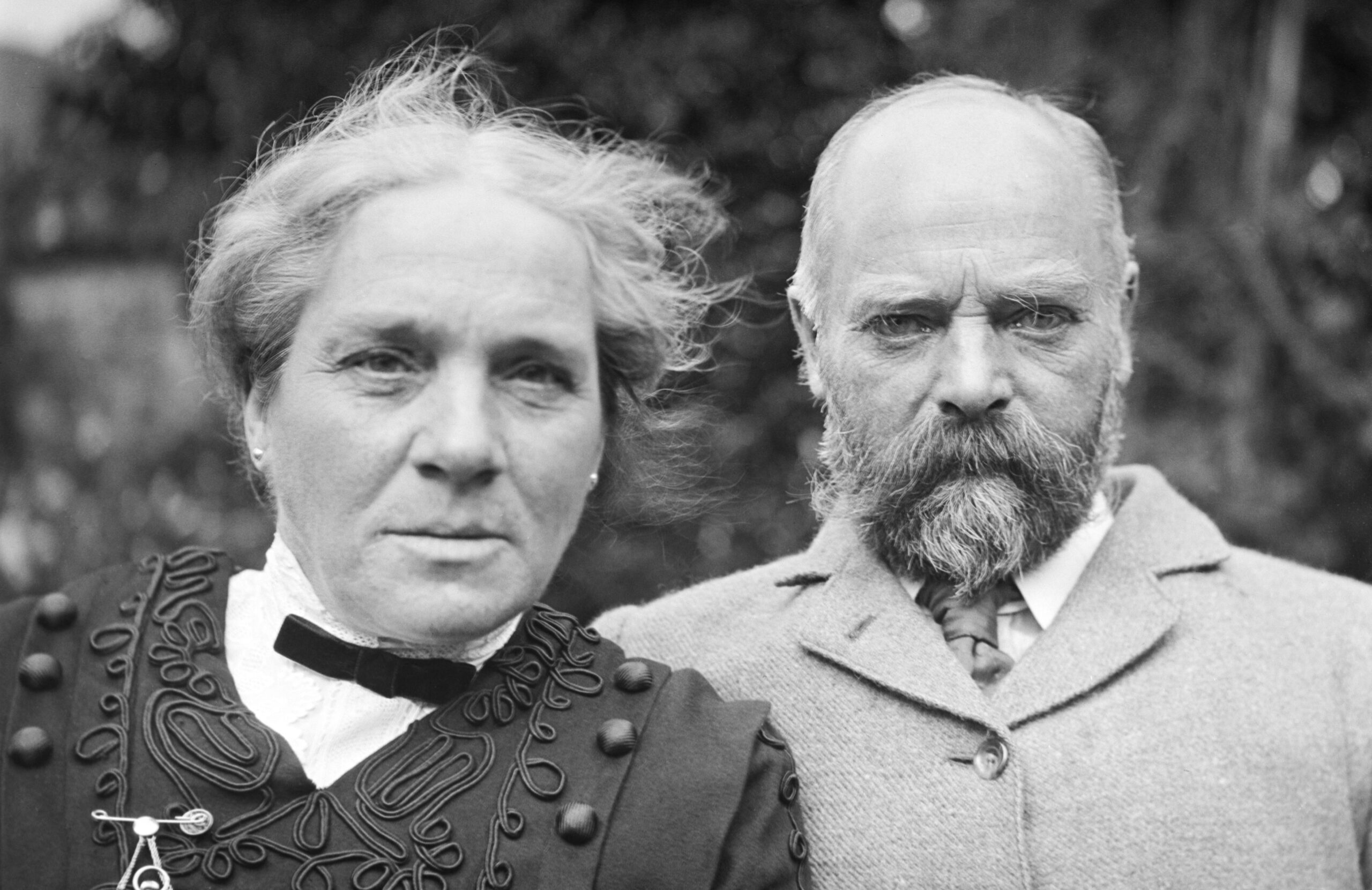
With more time on her hands, Gussie now became involved with the newly-formed West Dorset Branch of the National Union of Women’s Suffrage Societies (NUWSS),[11] serving for a time as their honorary treasurer.[12] Her reason for supporting the work of the non-militant NUWSS was clearly based on her belief in the moral fairness of giving women the vote, as she set out in a letter published in the Bridport News on 22 March 1912, written following the start of the militant WSPU’s window smashing campaign: [13]
‘Dear Sir, As a member of the committee of the West Dorset Branch of the National Union of Women’s Suffrage Society, I ask you to insert in your next these few remarks. In collecting subscriptions this year I am sorry to find that some of our members are falling off, giving as their reason the late behaviour of the militants in London.[14] I write to beg them to reconsider their decision, as now is the time to show our real keenness for the cause and not, because a few in their misguided zeal have broken the laws of the country, to forget the object we have in view, which is, by getting the vote to help all those poor over-worked, badly paid women who are being sweated and have no power to help themselves, as well as to give the vote to our highly-educated women in all branches of life. If women had the vote like the coal-strikers, it would be a different tale. I quite agree that laws must not be broken, but it seems hard for women to be given hard labour as a punishment for broken windows when men are only given much the same for far worse criminal offences, breaking God’s laws against women. Please let me beg all our members to stick together, not to be narrow minded, for the object is the same, but let us work and give more than ever. I can only trust that all who seriously wish for Women’s Suffrage for our country’s sake will support the cause more heartily than before. G.L. WILSON, Hon. Treasurer. Uploders House, March 18th, 1912.’
Gussie’s support for the cause extended so far as to hosting meetings at Uploders House. In July 1912, a meeting of the West Dorset Branch of the NUWSS was held at Uploders House where, despite the bad weather preventing many from attending, the position of the Women’s Suffrage movement was discussed and work for the future was decided upon.[15] The following year, in June 1913, a garden meeting of the Church League for Women’s Suffrage was held at Uploders House.[16] The meeting was chaired by Gussie’s husband Thomas who was clearly very sympathetic to the cause, saying to the audience ‘the women’s suffrage question was one which required a great deal of thought, and people should not be prejudiced against the cause because of what they read in the newspapers. It was a great question which they should all think about, for the more thought they gave to the subject the sooner they would come to the conclusion that things today were not as they should be.’[17]
Sadly, not everyone in West Dorset was sympathetic to the cause, as demonstrated by a poem published in the Bridport News on 16 May 1913 which openly mocked Bridport’s Women’s Suffrage Society.[18] In reply, an unattributed witty put-down in verse was published the following week, which I like to think Gussie may have had a hand in writing: [19]
‘BRIDPORT AND ITS WOMEN’S SUFFRAGE SOCIETY. A REPLY.
A would-be poet blossoms out
Within the Bridport News,
And on the Woman’s Suffrage cause
He wildly states his views.
He only shows his ignorance
Both of poetic laws
And of the subject which he deals
With, as the Suffrage cause.
T’is women who ‘re supposed to jump
Too quickly to conclusions;
Yet here we find some manly mind
In most absurd confusions.
For Suffragist and Suffragette
He muddles up completely
And then expects the former kind
To take his words most meekly.
Now Suffragette as we all know
To our intense disgust
Is one who has defied the laws
Which she still thinks unjust.
But Suffragist is one who takes
A wider, saner view;
She feels that through it all she must
To her own self be true.
She feels that she must use and give
Unto this world of ours
The whole, not but a half
Of her God-given powers.
She does not want to seek a seat
Within the legislation;
She only wants to be a part
Of his great, glorious nation.
Why does she want a vote? I think
That deep down in her soul
She feels it takes two halves – you know –
To make a perfect whole.’
In December 1913, Gussie and Thomas left Uploders House[20] and moved to Bonshaw at Broadstone in Dorset. The following year, on 4 August 1914, Britain declared war on Germany and the suffrage groups decided to suspend their campaign and to support the war effort. Dr Elsie Inglis (1864-1917), founder of the Scottish Women’s Suffrage Federation, formed the Scottish Women’s Hospital for Foreign Service (SWH). In 1915, with her son then serving with the 21st Manchester Regiment, Gussie made a donation to the work of the Scottish Women’s Hospital, which was then providing medical support in France and Serbia[21] and in May 1915 was joined by another Sherborne Suffrage supporter Evelina Haverfield. Sadly, Gussie’s only surviving son was killed in action on 28 November 1916, aged 33, when he was shot through the heart in the Beaumont-Hamel assault with the 21st Manchesters. He was buried in France but is remembered on the Broadstone War Memorial.[22]
Although Gussie’s campaigning days were now over she remained a keen supporter of women’s groups and in August 1920 hosted a dance and whist drive at Bonshaw for Broadstone Women’s Institute, which was attended by over 200 members and declared a great success![23]
Gussie’s husband Thomas died at Bonshaw on 4 January 1924. A few weeks later Gussie remade her will, bequeathing to her daughters Diana and Patience all her real and personal property to share and share alike for their separate use ‘and so that no husband shall have power or control over the same.’ Gussie died at ‘Bonshaw’ on 5 May 1929 and on 9 May was buried alongside her husband at Broadstone Cemetery.[24]
Rachel Hassall
2 March 2026
Footnotes:
[1] Ada Lovelace and the first computer programme in the world, Max-Planck-Gesellschaft https://www.mpg.de/female-pioneers-of-science/Ada-Lovelace (accessed 1 March 2026)
[2] Marie Curie, The Nobel Prize https://www.nobelprize.org/prizes/physics/1903/marie-curie/biographical/ (accessed 1 March 2026)
[3] The Story of Eleanor Coade, The Historic England Blog https://heritagecalling.com/2021/11/01/the-story-of-pioneering-businesswoman-eleanor-coade/ (accessed 1 March 2026)
[4] The Intellectual Property Office (IPO) https://www.gov.uk/government/organisations/intellectual-property-office/about (accessed 1 March 2026)
[5] Espacenet Patent search https://worldwide.espacenet.com/patent/ (accessed 1 March 2026)
[6] Patent No. 14,984, A.D. 1894, Gussie Louisa Wilson, A Hot Water Doll https://worldwide.espacenet.com/patent/search/family/032125043/publication/GB189414984A?q=gussie%20louisa%20wilson
[7] Patent No.519, A.D. 1897, Mary Alice Campbell, A New or Improved Device to be used for Crimping, Curling, or Waving Hair https://worldwide.espacenet.com/patent/search/family/032132848/publication/GB189700519A?q=Mary%20Alice%20Campbell
[8] TNA: RG12/1658, 1891 census for Greenhill, Sherborne. Ancestry website (accessed 1 March 2026)
[9] Dorset History Centre: NG-CC/A/S48, Report of the Committee of the Yeatman Hospital, 1904-1928.
[10] Sherborne School Archives, Diaries of Henry Robinson King (1855-1935).
[11] The West Dorset Branch of the NUWSS held its inaugural meeting at Bridport Town Hall on 17 August 1910. The meeting was reported in Common Cause on 1 September 1910. The British Newspaper Archive https://www.britishnewspaperarchive.co.uk/ (accessed 2 March 2026)
[12] Elizabeth Crawford, The Women’s Suffrage Movement in Britain and Ireland: A Regional Survey (Abington: Routledge, 2006), p.160.
[13] ‘West Dorset Women’s Suffrage Society’, Bridport News, 22 March 1912. The British Newspaper Archive https://www.britishnewspaperarchive.co.uk/ (accessed 2 March 2026)
[14] The 1st March 1912 saw the start of a Window Smashing Campaign by members of the Women’s Social and Political Union (WSPU).
[15] ‘Uploders. West Dorset Women’s Suffrage Society Garden Meeting’, Bridport News, 19 July 1912. The British Newspaper Archive https://www.britishnewspaperarchive.co.uk/ (accessed 2 March 2026)
[16] The Church League for Women’s Suffrage was founded in 1909 by the Rev. Claude and Mrs Hinscliffe to band together Christian Suffragists in order to secure for women the vote in Church and State. For further information see Elizabeth Crawford, The Women’s Suffrage Movement: A Reference Guide 1866-1928 (London: Routledge, 2001), p.111.
[17] ‘The Church League for Women’s Suffrage. Garden Meeting at Uploders House’, Bridport News, 20 June 1913. The British Newspaper Archive https://www.britishnewspaperarchive.co.uk/ (accessed 2 March 2026)
[18] The following poem by ‘Q’ appeared in the Bridport News on 16 May 1913. The British Newspaper Archive https://www.britishnewspaperarchive.co.uk/ (accessed 2 March 2026):
‘TO BRIDPORT AND ITS WOMEN’S SUFFRAGE SOCIETY (With due acknowledgments and apologies to the “Rejected Addresses”).
O Town of advance! where each dauntless dame
Abjuring her sex, cuts up rough and frets,
Knows no chaste alarm, ignores modest shame
To join in the cause of crazed Suffragettes.
And you who will quit your wool, cotton, and needle
In crowds to the floor of the Town Hall to flock,
Without hammer or bomb, I fear, you’ll not wheedle
The right to M.P. while still wearing a frock.
O why should the constant Asquith’s addresses
Fall damp as wet blankets on Suffragist fire?
Advance then, blue stockings, away with distresses,
And scream, yell, and shout for Pankhurst’s desire.
How well could a woman enact all the laws
Of Employment of children, and Nurse registration,
Divorce Acts and Housing, howe’er subtle the cause
She’ll tackle at speed, and without hesitation.
When the Suffragette skill has fashioned the Bill
To heal minds deficient, and the lad epileptic,
There’s a chance for poor man, if a bomb don’t him kill;
If you cannot see that, be blamed for a sceptic.
O, soon must ye burst the tyrannical shackles
Which each panting bosom indignantly names,
Until not one goose at the Capital cackles
Against the grand question of Suffragist claims.
And then shall the woman of country and city,
Who once held the helm of the sweet English home,
Hold the helm of the State, and without fear or pity
Steer spasmodically all ways, but ever to doom.’
[19] ‘Bridport and Its Women’s Suffrage Society. A reply’, Bridport News, 23 May 1913. The British Newspaper Archive https://www.britishnewspaperarchive.co.uk/ (accessed 2 March 2026)
[20] Notice of the auction of furniture of Mrs Wilson, late of Uploders House, Bridport News, 12 December 1913. The British Newspaper Archive https://www.britishnewspaperarchive.co.uk/ (accessed 2 March 2026)
[21] ‘The Scottish Women’s Hospital for Foreign Service… Funds Urgently Needed’, The Scotsman, 3 March 1915. Includes under a first list of donations: ‘Mrs G.L. Wilson, Bonshaw, Broadstone, Dorset – £1.0.0.’ The British Newspaper Archive https://www.britishnewspaperarchive.co.uk/ (accessed 2 March 2026)
[22] Broadstone War Memorial, Dorset in the Great War https://dorsetinthegreatwar.co.uk/war-memorials/broadstone-war-memorial/ (accessed 2 March 2026)
[23] ‘Women’s Institute’, Dorset County Chronicle, 19 August 1920. The British Newspaper Archive https://www.britishnewspaperarchive.co.uk/ (accessed 2 March 2026)
[24] FindaGrave https://www.findagrave.com/memorial/186317201/augusta-louisa-wilson (accessed 2 March 2026)