According to her legend, Juthware, or Juthwara (Judith), was a Saxon woman who lived sometime between the 6th and 8th centuries in Halstock, Dorset.
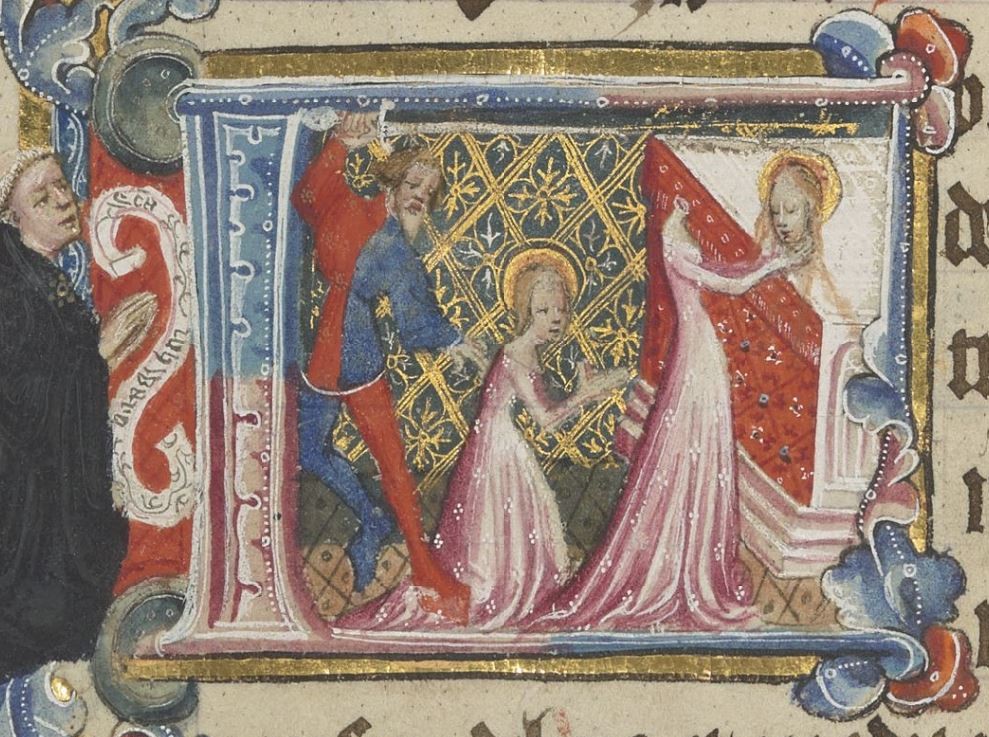
Juthware was very religious and known to pray and fast and to give alms to the poor. After her mother’s death, Juthware’s father remarried but when he too died Juthware began to experience chest pains. Her jealous stepmother hatched a plan to discredit Juthware, suggesting she placed soft cheeses on her breasts to ease the pain and then telling her son Bana that Juthware was pregnant. On examining Juthware, Bana concluded that her moist breasts indicated that she was pregnant and, rather than allow Juthware to bring shame on the family, Bana immediately cut off her head with his sword. A spring of water sprang up from the ground where Juthware’s head fell and, miraculously, Juthware picked up her own head and carried it to Halstock church where she placed in on the altar before dying. On realising that he had been tricked by his mother into killing Juthware, Bana became a monk.
In the 11th century, Bishop Alfwold moved St Juthware’s remains to Sherborne Abbey, where he dedicated a shrine to her which became a place of pilgrimage until the dissolution of Sherborne Abbey in 1539.
The Sherborne Missal, which dates from about 1400, includes on 13th July a Mass for St Juthware with a marginal illustration by John Sifrewas (a Dominican friar) of her martyrdom. The Missal would have been used on the high altar in Sherborne Abbey on special occasions.
The Sherborne Missal is now held at the British Library, but a digital copy can be viewed at Sherborne Museum.
Today, the only reminder of St Juthware’s connection with Sherborne Abbey is her image which can be seen in the Great East Window (designed in the 1850s by Clayton & Bell) where she is depicted holding her severed head.
In the village of Halstock, the tradition of St Juthware is remembered in the place name of Judith Hill, also known as Abbots Hill, and by stories of a haunted lane along which the ghost of a woman can be seen carrying her severed head.
In July 2012, the parish church of Halstock St Mary had its dedication extended to include St Juthware.
Rachel Hassall