Daphne Blake Oram was born at Devizes in Wiltshire on 31 December 1925, the youngest child and only daughter of James Oram MBE (1890-1964) and Ida Murton Oram (née Talbot) (1887-1972), of Belle Vue House, Devizes. Daphne’s middle name was the maiden name of her grandmother Alice Blake (1851-1941).
Daphne’s father was a town councillor in Devizes and in 1937 was appointed town mayor. He was also a JP and Chair of the Wiltshire branch of the Coal Merchants’ Federation. In 1958 he became President of the Wiltshire Archaeological and Natural History Society (WANHS), which society Daphne was also a member of for many years.
Daphne’s early passion for music was evident when in 1936, aged 10 ½, she won a prize for her pianoforte playing at a miniature Eisteddfod held in Devizes Town Hall. She attended Devizes Secondary School and from 1939 to July 1943 was a pupil at Sherborne School for Girls (Kenelm), where she studied piano, organ and musical composition.
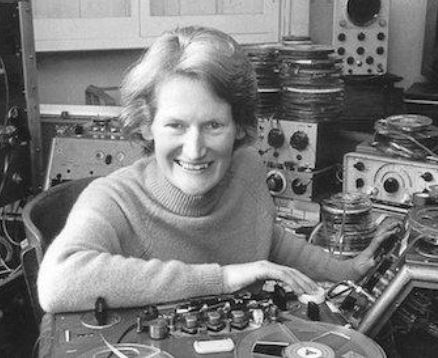
Daphne was offered a place at the Royal College of Music but decided instead to join the BBC as a Junior Studio Engineer where, during the Second World War, she was tasked with shadowing their live concert broadcasts with a pre-recorded version in case of interruption by enemy bombing. She became interested in the developments in synthetic sound and began experimenting with sounds on tape. In 1958 she was invited by the BBC to co-found with Desmond Briscoe the BBC Radiophonic Workshop, where she was the first Studio Manager and worked on various projects including the theme tune for Quatermass and the Pit (1958-59) and the sound effects for Major Bloodnok’s stomach for The Goon Show. Daphne left the BBC Radiophonic Workshop in 1959 but her work there paved the way for Delia Derbyshire who arrived the following year and co-created the iconic theme music for the BBC TV series Doctor Who.
In 1959 Daphne set up the Oramics Studio for Electronic Composition at Tower Folly, Fairseat, Wrotham, Kent, where she developed pioneering equipment including the Oramics machine and created the Oramics technique for creating electronic sounds using drawn sound. She also worked on material for radio, television, theatre and films, including the soundtracks for The Innocents (1961), Dr No (1962), Snow (1963), and Goldfinger (1964). She also collaborated with composers and created concert works, including Four Aspects (1970).
In her book An Individual Note: of Music, Sound and Electronics (London & New York: Galliard Ltd, 1972) Daphne investigated the relationships between music, sound and electronics. It has been described as ‘a playful yet compelling manifesto for the dawn of electronic music and for our individual capacity to use, experience, and enjoy it.’ A new edition with an introduction by Sarah Angliss was published in 2016 by the Daphne Oram Trust.
Daphne Oram died on 5 January 2003, aged 78.
The Daphne Oram Trust was founded in 2007 with the aim of advancing and developing the appreciation of the art of electronic music and the pioneering work of composer and sound artist Daphne Oram (1925-2003). In 2017 the Oram Awards were launched by the PRS Foundation and the New BBC Radiophonic Workshop to celebrate ’emerging artists in the fields of music, sound and related technologies in honour of Daphne Oram, and other pioneering women in music and sound.’
In 2019, the Daphne Oram Creative Arts Building was opened at Canterbury Christ Church University, where Daphne was a tutor in the 1980s. The aim of this creative hub is to support and inspire the next generation of artistic professionals.
Rachel Hassall
See also:
- Daphne Oram Collection, Goldsmiths, University of London.
- Sarah Rawlins, Birth of the Radiophonic Workshop (Science & Media Museum)