Mary Hudson was born in Londonderry, Northern Ireland in 1745. Her mother Susannah Hudson (c.1720-1778) remarried in 1765 at St Andrew, Holborn, to Thomas Kirby, who died in January 1773 in Sherborne.
Mary was married on 14 February 1767/8 at the church of St Bartholomew the Less in London, to William Willmott (1741-1787), a silk throwster of Sherborne.
John Sharrer, a silk throwster of Whitechapel in London, had acquired in 1753 a water grist mill and house (now the site of Riverside House) in Westbury, Sherborne, where he started a silk throwing business. On 2 May 1764, John took his nephews George Ward and William Willmott into partnership in his Sherborne business and, following John’s death, George and William dissolved the partnership and divided the business, with William carrying on the Dorset-side of the silk throwing business in Sherborne, Cerne Abbas and Stalbridge, while George took over the business in Bruton, Somerset.
William carried out improvements to his silk mill in Sherborne, installing a larger water wheel in 1778 and a horsemill and horsewalk in 1781. He also acquired a silk mill in Dorchester, and in 1783 further expanded his business by purchasing with John Norman a silk-throwing mill in Taunton, Somerset.
William Willmott died after a short illness on 2 June 1787, aged 46, leaving his wife Mary with seven children to support.
Mary had been involved in the business prior to William’s death, but now she took over the management of business until her sons, John (b.1772), Thomas (b.1778) and Henry (b.1784) came of age.
Shortly after William’s death, Mary wrote to one of their largest clients: ‘Your friendly letter came safe to hand. I had before ordered my Clerk to inform you of the dreadfull misfortune that has befallen me. It has pleased God to support me under so heavy a calamity. I trust his goodness will give me health and spirits to go through the laborious task I must now take upon me of carrying on the business for the maintenance of my seven helpless Children. I hope Gentlemen you will continue to send me Silk and I will endeavour to have it well done. I am left one of the Executors of my husband’s Will…’
On 9 June 1787 an inventory was made of the effects in William’s silk mills in Sherborne, Cerne Abbas and Dorchester. One of Mary’s first steps on taking over the management of the business was to sell their half-share in the Taunton mill to William’s partner John Norman.
In December 1800, Mary took her son Thomas Willmott (1778-1834) into partnership. Following Mary’s death in Bath on 11 October 1815, ‘after a lingering illness’, Thomas took over the running of the business.
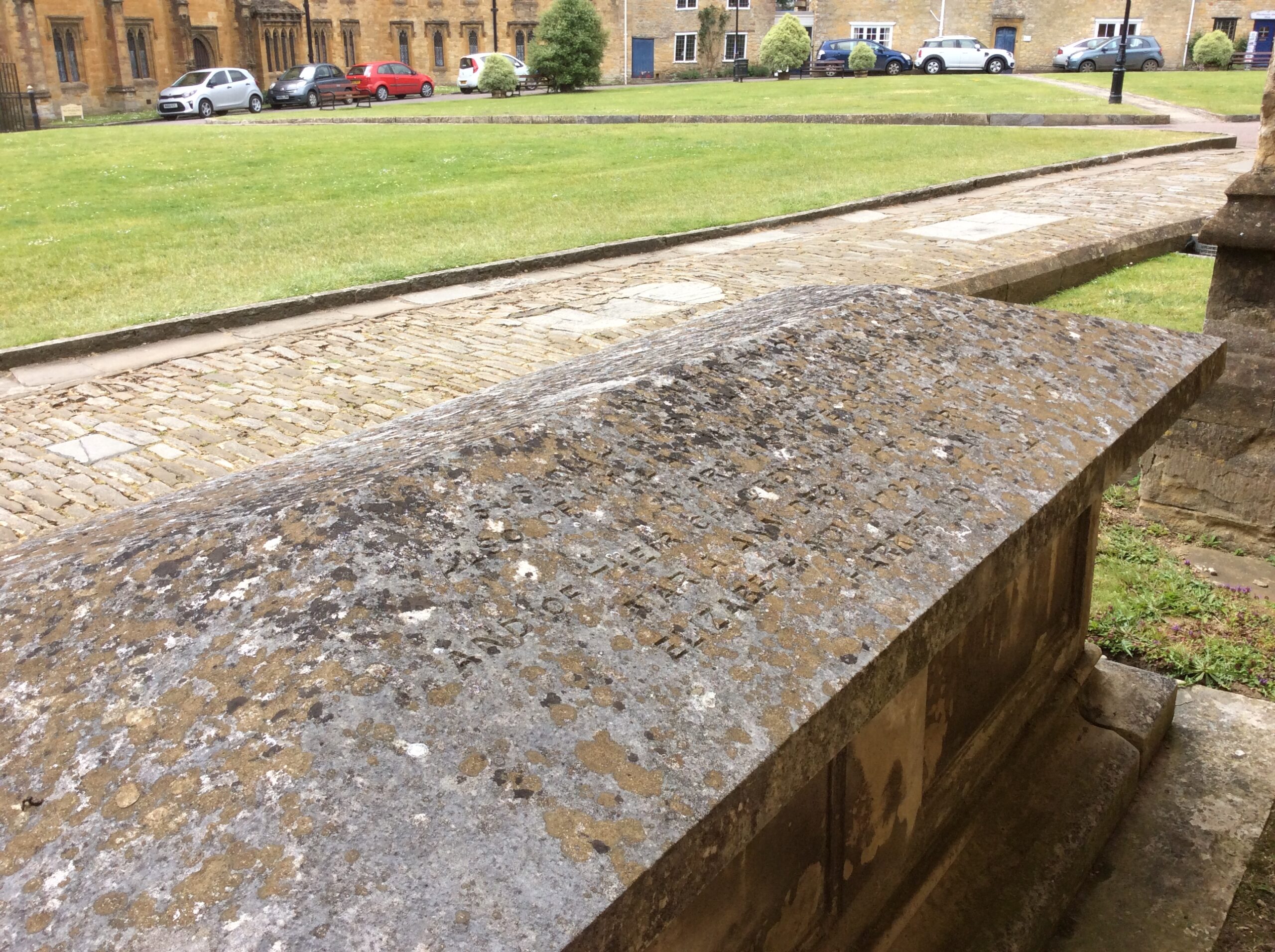
Mary Willmott is commemorated with other members of her family, including her husband William Willmott (1741-1787) and her mother Susannah Kirby (c.1720-1778), on a table tomb outside the main entrance to Sherborne Abbey.
Rachel Hassall
See also:
- The papers of the Willmott of Sherborne, Silk Throwers, 1728-1898, are held at the Dorset History Centre (ref.D-WIL)
- Mary Willmott’s grave in Sherborne Abbey churchyard (FindaGrave)
Further reading:
- Elizabeth O. Cockburn, Sherborne Silk Mills and Marglass (Sherborne Museum Association, 2nd ed., April 1991)
- Frederick Marsden: ‘A Short History of Sherborne Silk Mill from 1753 onwards’, Journal of the Sherborne Historical Society, 8, 1971.
- Henry Symonds, ‘The Silk Industry in Wessex’, Proceedings of the Dorset Natural History and Archaeological Society, 37, 1916.
- Maureen Weinstock, ‘Portrait of an eighteenth century Sherborne Silk Mill Owner’, Studies of Dorset History (1953)